Featured Stator Manufacturing Systems for European Assemblers
From standalone precision servo lacing to turnkey slot-to-final-forming stator lines. Fully compatible with copper and enameled aluminum wire setups across standard IEC frame sizes.
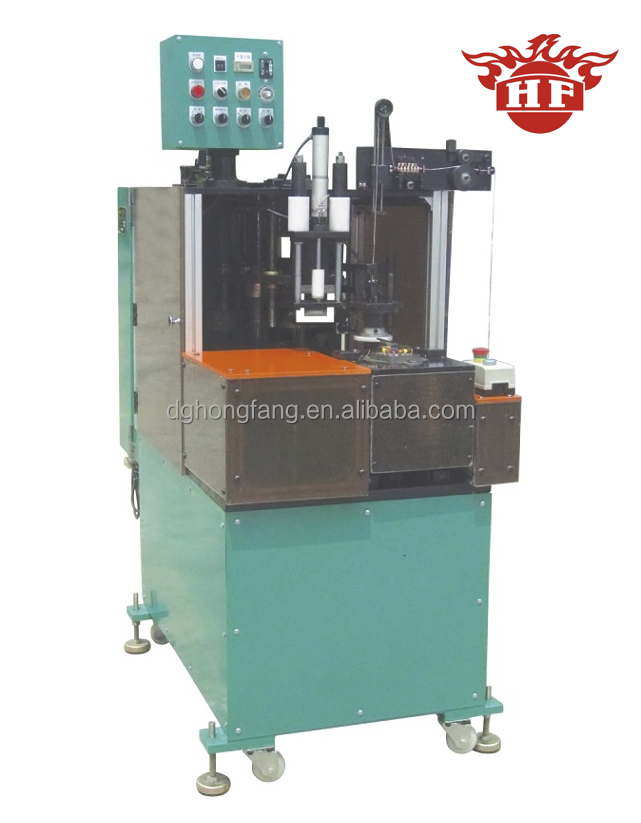
HF-BS20 Servo Automatic Coil Double Side Lacing Machine
- Dual-side simultaneous binding
- Servo indexing & tension control
- 1000W / 220V/380V Industrial Rated

Coil & Wedge Paper Inserting Machine
- Simultaneous coil & wedge transfer
- Custom-profiled pushing fingers
- Eliminates wire insulation micro-tears

HONGFANG Motor Stator Coil Forming & Shaping Machine
- Hydraulic/pneumatic expansion blocks
- Accurate coil-head clearance control
- 1 kW robust hydraulic power pack

Automatic Stator Wedge & Coil Inserter for Fan Motor
- Precision gear transmission parts
- Automated wedge paper feed & cutoff
- 1-Year complete mechanical warranty

HONGFANG HF-D50 Green Insulation Paper Insertion Machine
- Automated creasing, cutting, punching
- Zero slot-edge flare / zero breakdown
- Cooler, pump & blower stators

Hot Sale Armature Winding Machine for Fan Motor
- High-speed dynamic flyer winder
- Precision commutator hook indexing
- Applicable for DC & universal rotors

Six Stations Outer Stator Motor Coil Winding Machine
- Synchronous multi-pole winding
- Automated terminal pin looping
- PLC digital tension control system

Fully Automatic Fan Motor Coil Winding Machine
- Dual wire compatibility (0.1–1.2 mm)
- Multi-controller parameter memory
- Continuous mass manufacturing design
Kinematics & Dielectric Integrity in Automated Double-Sided Stator Coil Lacing
Modern electric motor fabrication in the Paris industrial basin—stretching from the automotive clusters of the Yvelines (Poissy, Flins) to aerospace and mechatronic facilities in Essonne and Seine-Saint-Denis—faces stringent reliability standards. Stator end windings are prone to mechanical displacement under transient electrodynamic surge forces (Lorentz forces up to dozens of Newtons during inverter switching and starting currents). Without uniform, high-density structural consolidation, individual copper conductors experience microscopic relative friction, resulting in fretting degradation of the enamel insulation, partial discharge (PD), and premature phase-to-phase breakdown.
The automatic double-side stator coil lacing machine (exemplified by the servo-driven HF-BS20 architecture) represents a definitive technological leap over legacy single-sided or manual binding methods. By employing twin independently driven or mechanical cam-synchronized lacing needles, the system laces both the lead end (connection side) and non-lead end simultaneously. This structural symmetry neutralizes axial distortion of the slot wedges and eliminates uneven bending forces that typically cause stator tooth deflection or core lamination delamination.
Structural Advantages of Servo-Driven Twin-Needle Binding
In high-vibration applications—such as auxiliary electric steering motors, onboard aerospace fans, and high-speed rail HVAC blowers—conventional single-sided lacing leaves the opposing coil overhang unrestrained during the binding stroke, inducing asymmetrical copper pack compression. The HF-BS20 double-sided lacing architecture eliminates this bottleneck through three distinct mechanical mechanisms:
Synchronized Needle Vectors
Dual hooked needles plunge simultaneously from the top and bottom faces. Tensioning arms maintain a constant feeding pull, preventing cord slackness while ensuring the lacing knot seats firmly on the outer crown of the slot liner.
Programmable Stitch Geometry
Via the touchscreen HMI, operators switch between continuous slot-by-slot lacing, interval skipping (skip-slot lacing for specific pole groupings), and multi-turn boundary knotting to accommodate sensor cables and lead wire breakouts.
Dielectric Margin Preservation
Controlled servo positioning prevents needle contact with magnet wire enamel. Polished tungsten carbide needle tips ensure zero scraping, preserving insulation breakdown margins up to 4000V AC dielectric proof test.
Technical Matrix: HF-BS20 Double-Side Lacing vs. Conventional Binding
| Evaluation Parameter | HF-BS20 Servo Double-Side Lacing | Semi-Automatic Single-Side Machine | Manual Hand Lacing Bench |
|---|---|---|---|
| Cycle Time (36-Slot Stator) | 18 - 25 seconds (Both sides complete) | 50 - 65 seconds (Requires manual flipping) | 180 - 300 seconds |
| End-Turn Overhang Symmetry | ±0.3 mm concentricity deviation | ±1.2 mm (axial slant common) | Operator skill-dependent (>2.5 mm) |
| Wire Insulation Damage Risk | 0% (Servo optical sensor safety interlock) | Low-Medium (Mechanical cam drift) | High (Hand tool abrasion) |
| Lacing Cord Compatibility | Polyester, Nomex®, Polyaramid, Glass fiber | Polyester, Nylon cords | Broad, but variable tension |
| Air Gap Clearance Integrity | Guaranteed; no inner bore intrusion | Possible bore contamination | Frequent manual post-dressing required |
| Labor Allocation | 1 Operator manages 2-3 machine cells | 1 Dedicated operator per machine | 1 Dedicated skilled artisan |
Target Applications Across Île-de-France & Northern French Motor Hubs
As the European Union accelerates its decarbonization timeline under the Fit for 55 legislation and France pushes forward its France 2030 national re-industrialization roadmap, motor production across the Paris metropolitan territory is undergoing significant modernization. The demand for compact, copper-dense, and vibration-resistant stators has surged across four critical regional application domains:
EV & Hybrid Auxiliary Actuation
Paris and surrounding Tier-1 suppliers (e.g., Valeo, Faurecia clusters) build auxiliary brushless DC and PMSM stators for electronic power steering (EPS), electric brake boosters (e-boosters), and high-voltage refrigerant compressors requiring compact coil heads.
Railway Transit & Grand Paris Express
Rolling stock projects centered around Alstom and engineering contractors in Saint-Ouen require heavy-duty auxiliary fan and blower motors operating continuously under extreme cyclic vibration inside underground tunnel ventilation and train car climate systems.
Industrial HVAC & RE2020 Compliance
France's stringent environmental regulations (RE2020) mandate high-efficiency variable-speed motors (IE4/IE5 Super Premium Efficiency) in heat pumps, air curtains, and cleanroom fans across high-tech commercial facilities in La Défense and Roissy.
Macro Industry Trends Shaping Motor Automation in the French Market
European electric motor manufacturing has departed from low-cost, labor-intensive manual assembly. Procurement executives in the Paris area now focus heavily on total cost of ownership (TCO), automated line reconfigurability, and complete traceability. The following three industry shifts are shaping machinery selection across France:
1. Strict Carbon Footprint & Scrap Minimization: With raw material costs for enameled electrolytic copper hovering at historic highs, French motor plants cannot afford wire scuffing or end-turn cutting errors during post-insertion dressing. The automated integration of intermediate shaping, double-sided lacing, and final dimension calibration ensures that winding overhangs do not encroach on motor end-bell cavities, avoiding costly stator rewinding or disposal.
2. Rapid Tooling Changeover for High-Mix / Low-Volume Production: Parisian mechatronics manufacturers frequently manufacture diverse motor variants on the same line—switching between 24-slot fan stators, 36-slot pump motors, and 48-slot industrial servomotors. Our machinery utilizes modular quick-change clamping collars and pre-stored recipe profiles within the PLC, allowing tool changeover within 15 to 20 minutes.
3. Electrical Compliance with CE & Low-Voltage Safety Standards: French health and safety labor inspectors (CARSAT / Inspection du Travail) enforce strict mechanical enclosure guarding, dual-channel emergency stop circuits (Cat. 4 / PL e according to EN ISO 13849-1), and optical safety light curtains. Zunqi machines exported to the European Union feature certified safety relays, CE documentation, and clean industrial electrical wiring cabinets.
Why Parisian Motor Manufacturers Partner with Zunqi Intelligent Equipment
Zunqi Intelligent Equipment Co., Ltd. operates out of Qishi Town, Dongguan—the epicenter of advanced precision machinery fabrication in South China. Over the past 17 years, we have evolved from a specialized winding jig and toolmaker into a full-scale exporter of automated stator and rotor production systems. Rather than operating as an unverified broker, Zunqi maintains direct manufacturing facilities, strict in-house CNC machining centers, and verified credentials on Alibaba.com.
Tailored Tooling to Your Stator Geometry
We do not deliver off-the-shelf, ill-fitting machines. Parisian buyers send their stator drawings (outer diameter, internal bore, slot depth, stack height) or physical lamination samples. Our engineers design, CNC-machine, and test the dedicated lacing and inserting tooling specifically for your motor model.
Pre-Shipment Trial Run & Video Validation
Before any crate departs our factory, we run continuous test cycles using your actual stator samples and wire diameter. We provide high-definition trial-run video documentation, cycle time reports, and dielectric test verification for your engineering team's sign-off.
Configurable Western Electrical Platforms
To ease onsite integration and routine spare-parts replenishment for maintenance crews in France, our control cabinets can be configured with premium componentry including Siemens, Schneider Electric, Mitsubishi, Omron, Delta, or SMC pneumatics.
Frequently Asked Questions by Industrial Buyers in Paris
Detailed technical, logistics, and compliance answers tailored to purchasing directors and plant engineers across France.
