Engineered Motor Stator & Rotor Assembly Machinery
Precision multi-station winding, automated insulation paper insertion, hydraulic wedge pressing, and high-tensile coil lacing machines ready for fast deployment in Kyiv workshops and manufacturing plants.

New Slot Paper Inserting Cutting Machine
- Application: Table Fan, Pump & Cooler
- Power: 1 kW · 380V/220V Dual Tap
- Warranty: 1 Year · CNC Feeder

Fully Automatic Fan Motor Coil Winding Machine
- Wire: Copper & Aluminum Wire Capability
- Control: Multi-Axis Precision PLC Drive
- Duty: Continuous Manufacturing Plant Grade

HF Single Side Lacing Machine for Stators
- Rating: 1000W · 380V / 220V Compatible
- Indexing: High-Precision Needle Pitching
- Application: End-Turn Binding Reinforcement

Hot Sale Armature Winding Machine for Fans
- Rotor Type: Slotted Commutator Armatures
- Tensioner: Dynamic Constant Friction Unit
- Efficiency: High Speed Automated Indexing

HONGFANG Stator Coil Forming & Shaping Machine
- Hydraulic: Progressive Head Forming Press
- Power: 1 kW · Solid Steel Base Frame
- Compliance: ISO9001 Factory Quality Control

Two Stations Outer Stator & Coil Winding Machine
- Stations: Dual Turret Simultaneous Cycle
- Flexibility: Motor Stators & Transformers
- Repeatability: ±0.02mm Wire Layering
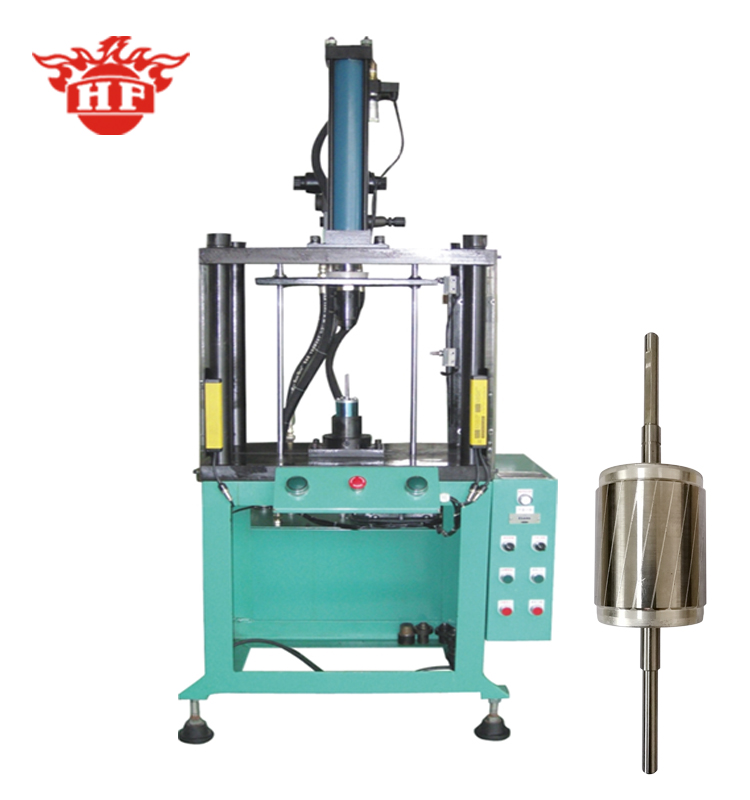
HF-W50 Rotor & Shaft Inserting Hydraulic Press
- Control: Pressure & Depth Sensor Feedback
- Protection: Eliminates Shaft Runout Flaws
- Application: Rotor Core Interference Fitting
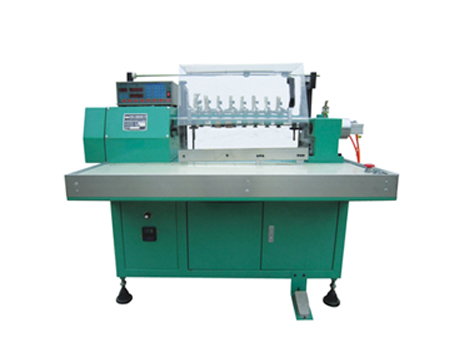
Cooler & Pump Stator Coil Winding Machine
- Capacity: Deep Slot Heavy Gauge In-Slot
- Controller: Industrial Digital Touch HMI
- Speed: Continuously Variable Servo Tapping
Stator Winding & Coil Insertion Engineering: The Definitive Technical White Paper
In modern electrical rotating machines, the stator constitutes the electro-magnetic core governing operational efficiency, thermal stability, and torque density. Whether producing single-phase fractional horsepower (FHP) motors or severe-duty three-phase induction drives, the automation of stator manufacturing—specifically the continuous sequence of slot insulation paper insertion, precision coil winding, combined coil and wedge insertion, intermediate forming, CNC lacing, and final dimensional shaping—determines whether a factory achieves international efficiency ratings (IEC 60034-30-1 IE2 to IE4).
For electromechanical plants, rewinding facilities, and OEM builders in the greater Kyiv metropolitan region (including Podil, Obolon, Darnytsia, and surrounding manufacturing clusters like Brovary and Bila Tserkva), optimizing the slot fill factor (η) while eliminating enamel wire abrasion is the primary technical bottleneck. Conventional manual insertion methods frequently yield slot fill ratios below 68%, accompanied by asymmetrical end-turn geometry that provokes localized magnetic saturation, excessive coil overhang reactance, and early thermal insulation breakdown under continuous inverter-fed PWM stresses.
Automated motor winding insertion machines (combined coil and slot wedge inserters) resolve these thermodynamic and electromagnetic deficiencies through simultaneous mechanical transfer. Operating via high-torque CNC servo actuators coupled to precision ground ball screws, these machines drive multi-tine pusher guides and push needles directly into the stator bore. In a single synchronized downward stroke, the machine feeds pre-folded insulating wedges (Nomex, DMD, or polyester film) from raw roll stock while sliding the pre-wound concentric or distributed winding groups through narrow slot mouths without scoring the magnet wire enamel.
By automating the wedge shearing, cuff folding, and insertion stroke into an uninterrupted 8-to-15 second operational cycle, manufacturers eliminate manual coil pinching and wedge displacement defects. This ensures that the resultant stator core possesses identical phase resistances, balanced phase inductances, and pristine ground insulation barrier reliability—essential criteria for passing stringent high-potential (Hi-Pot) test standards (typically 2 x Unominal + 1000V) and surge comparison testing prior to varnish impregnation.
Localized Industrial Application Scenarios Across Kyiv & Regional Hubs
Industrial operations across Kyiv Oblast and Ukraine's central economic corridor encounter unique technical and operational challenges. Rebuilding critical civic infrastructure, ensuring unbroken municipal heating and water pumping, and revitalizing agricultural processing facilities demand robust motor winding and inserting automation tailored to local electrical and environmental realities:
Municipal Water & District Heating
Continuous rewinding and manufacturing of submersible pumps, sewage lift motors, and district heating circulation pumps operated by municipal utilities like Kyivvodokanal and regional utility operators.
Agro-Industrial Processing Plants
Heavy-duty motor winding for grain elevators, feed mills, sunflower oil extraction presses, and pneumatic conveying blowers in Fastiv, Bila Tserkva, and suburban agribusiness complexes.
HVAC, Ventilation & Cold Storage
Automated coil winding and wedge insertion for commercial chiller units, exhaust ventilation fans, and industrial air handling equipment installed in modern logistics warehouses and healthcare facilities.
Transit & Material Handling Systems
Rewinding and assembly of traction auxiliary motors, elevator hoisting machinery, overhead gantry crane drives, and rolling stock auxiliary ventilation drives for regional rail and transit networks.
Strategic Engineering Trends Reshaping Ukraine's Motor Manufacturing Landscape
The electromechanical manufacturing sector in Kyiv and Ukraine is undergoing an accelerated modernization cycle driven by post-war recovery imperatives, decentralized energy constraints, and integration with European Union trade standards:
Transition from GOST to IEC / DIN Standards
Ukrainian equipment builders are actively replacing legacy Soviet GOST frame configurations (AIR, 4AM, 5A series) with European standard IEC/DIN dimensions (IEC 63 to 225 frames). Our insertion machines feature rapid modular changeover tooling that accommodates both legacy metric slot laminations and modern European low-loss silicon steel architectures.
High-Efficiency (IE3/IE4) Adoption
With electrical tariffs rising and regional power grid resiliency paramount, Ukrainian plants cannot afford high-loss rewind jobs. Automated coil inserting enables tightly packed stator slot geometries with fill factors exceeding 75%, allowing manufacturers to build premium IE3 and super-premium IE4 induction and synchronous reluctance stators.
Workforce Optimization Through Automation
Severe industrial labor shortages across central Ukraine necessitate automated production machinery that replaces tedious hand-winding and slot-wedging tasks. A single operator running our linked winding and insertion cells can match the daily stator throughput of 6 to 8 skilled manual winders while eliminating human fatigue errors.
Automated Coil Insertion vs. Conventional Manual Rewinding
For procurement directors and chief engineers in Kyiv conducting cost-benefit analyses, the following engineering matrix demonstrates why semi-automatic and fully automatic machine lines deliver an immediate return on investment:
| Performance Criterion | Manual Slot Winding & Wedging | Zunqi Automated Insertion Line | Engineering Benefit |
|---|---|---|---|
| Cycle Time Per Stator | 25 – 60 Minutes (Operator Dependent) | 12 – 25 Seconds (Programmable Stroke) | Up to 100x Throughput Acceleration |
| Maximum Slot Fill Factor (η) | 55% – 65% (Risk of Jamming) | 72% – 78% (Controlled Guide Blades) | Enhanced Torque, IE3/IE4 Energy Ratings |
| Enamel Coating Integrity | High Risk of Scuffing from Raw Tools | Zero Wire Scraping; Hardened Guide Tines | Drastic Reduction in Turn-to-Turn Shorts |
| End-Turn Overhang Geometry | Irregular Overhang; Risk of Rotor Rubbing | Uniform Radial Symmetry & Pre-Shaped Flanges | Optimal Cooling Airflow; Quiet Operation |
| Lamination Accommodation | Inconsistent Finger Pressure Flaws | Rigid Air-Gap Clamping & Bore Mandrel | Preserves Low-Loss Silicon Steel Stacks |
| Primary Labor Requirement | Highly Skilled Craftsman Required | Standard Line Operator via Touchscreen HMI | Insulation from Regional Skill Scarcities |
Manufacturing Authority: Zunqi Intelligent Equipment Co., Ltd.
Headquartered in Qishi Town, Dongguan City—China's preeminent high-precision manufacturing belt—Zunqi Intelligent Equipment Co., Ltd. has specialized for more than 17 continuous years in the development, assembly, and worldwide export of motor stator and rotor automation machinery. Employing an elite workforce of 51 to 100 specialized mechanical design engineers, electrical programmers, and precision fitters, Zunqi maintains verified factory facilities certified onsite through Alibaba.com and international auditing bodies.
Unlike generic trading houses, Zunqi designs and machines critical stator tooling in-house. Our inserting push rods, segment guide tines, and forming dies are fabricated from high-grade alloy steels (Cr12MoV / DC53) subjected to vacuum cryogenic heat treatment, achieving surface hardnesses exceeding HRC 60 for exceptional wear resistance against abrasive enamelled copper and aluminum conductors.
Custom Stator Tooling
Each machine is engineered around your physical stator lamination samples or CAD dimensional blueprints (OD, ID, stack length, slot opening geometry, and cuff angle).
Tier-1 Control Architecture
Configurable with global component standards readily stocked and supported across Europe, including Siemens, Schneider, Mitsubishi, Delta, Inovance, Omron, and SMC pneumatics.
Sample Trial Verification
Before shipment, we execute trial production runs using your physical lamination samples, delivering full video validation and dimensional inspection reports prior to dispatch.
Long-Term Warranty & Spares
Full 1-year comprehensive machinery warranty backed by lifetime spare parts availability, remote video setup support, and rapid wearing blade re-supply.
Step-by-Step Stator Production Line Configuration
A turnkey electric motor stator production cell incorporates matched machines calibrated for synchronized cycle times, minimizing work-in-progress (WIP) inventory between manufacturing stages:
Slot Paper Insertion
Automatic roll feeding, creasing, edge cuffing, length cutting, and bottom insertion into every stator slot within 0.5 sec/slot.
Multi-Spindle Coil Winding
Continuous automated winding of magnetic wire into precision stepped transfer tooling forms with programmable layer pitches.
Combined Coil & Wedge Insertion
Single-stroke simultaneous transfer of phase coil groups and pre-formed slot wedges directly into lamination slots via servo pushers.
Intermediate Coil Forming
Progressive hydraulic expansion of coil head overhangs away from the central bore, ensuring zero interference before lacing.
Dual-Side Stator Lacing
Simultaneous automated cord stitching and knotting of both coil head ends with programmable skip-slot and diamond patterns.
Final Dimensional Sizing
Precision final forming dies press coil heads to exact axial and radial dimensional tolerances required for frame insertion.
Rotor Fine Turning
High-precision lathe skimming of squirrel-cage rotor outer diameter to hold tight uniform air gap tolerances (±0.015mm).
Hydraulic Shaft Pressing
Load-monitored hydraulic press-fitting of precision motor shafts into rotor cores preventing runout and core distortion.
Frequently Asked Questions: Purchasing & Importing in Kyiv, Ukraine
Practical answers to common commercial, logistical, and technical queries raised by Ukrainian purchasing managers, electrical factory directors, and electromechanical shop owners:
Q1: How are machines shipped to Kyiv under current logistical conditions?
We routinely arrange multi-modal freight to Ukraine. Ocean containers ship from Shenzhen or Guangzhou ports to primary European transit hubs such as Gdańsk or Gdynia (Poland) or Constanța (Romania), followed by bonded overland truck transport directly to Kyiv customs clearance terminals (e.g., Kyiv-Zakhidnyi or Sviatoshyn customs posts). All equipment is secured inside heavy-duty, fumigation-free vacuum-sealed plywood crates with anti-corrosion VCI barrier foil.
Q2: Are machines compatible with Ukraine's local electrical power grid?
Yes. Our machines are wired to meet European standard three-phase 400V / 230V ±10% at 50 Hz. To protect sensitive servo drives and PLC controllers against localized voltage sags or emergency grid fluctuations experienced in Kyiv Oblast, we can integrate broad-tolerance input line reactors, specialized surge suppressors, or step-up/down isolation transformers upon request.
Q3: Can tooling be fabricated for unique or legacy Ukrainian motor stators?
Absolutely. We build custom inserting pushers, wedge guides, and forming molds specifically matched to your physical stator laminations. Clients in Kyiv simply send us technical blueprints (DXF, DWG, or PDF) or courier a sample stator core to our Dongguan engineering workshop. We conduct full dimensional verification and return sample wound units for your metallurgical and electrical evaluation.
Q4: How is technical commissioning and operator training handled in Kyiv?
We provide full remote commissioning packages, including step-by-step high-definition video operating guides, annotated electrical schematics, touchscreen interface options (configured in English with Ukrainian operator glossaries), and direct engineer-to-engineer video conference support. Many plants in Brovary, Fastiv, and Kyiv complete setup and start serial production within 48 hours of crating removal.
Q5: What documentation is supplied for customs clearance and conformity?
Each shipment is accompanied by commercial invoices, packing lists with exact HS code classifications (typically 8479.81 / 8479.89), Certificates of Origin, machine CE Declarations of Conformity, and comprehensive factory test inspection certificates to facilitate rapid customs clearance under Ukrainian import regulations.
Q6: What is the standard manufacturing lead time and minimum order quantity?
Our minimum order quantity (MOQ) is strictly 1 set for all standalone winding, inserting, forming, and lacing machines. Standard production lead time for standard models is 20 to 30 calendar days; custom tooling builds for specialized multi-slot stators typically take 35 to 45 calendar days, inclusive of sample trial runs.
Upgrade Your Stator Production Line in Kyiv Today
Send your stator core drawings, wire gauge parameters, and target daily output to our senior engineering desk. Receive a tailored tooling proposal, cycle time analysis, and competitive factory-direct quotation within 9 hours.
