Featured Stator Coil Preforming, Winding & Forming Systems
Direct from our specialized Dongguan manufacturing base, explore our field-tested portfolio engineered for Gingerland electric motor factories. All tooling is customized to your exact lamination stack blueprints.

Two Stations Transformer Coil Winding Machine Motor Coil Winding Machine 2 Station Outer Stator Winding Machine
- Dual-station synchronized winding
- High slot-fill outer stator profiling
- Programmable tension control array
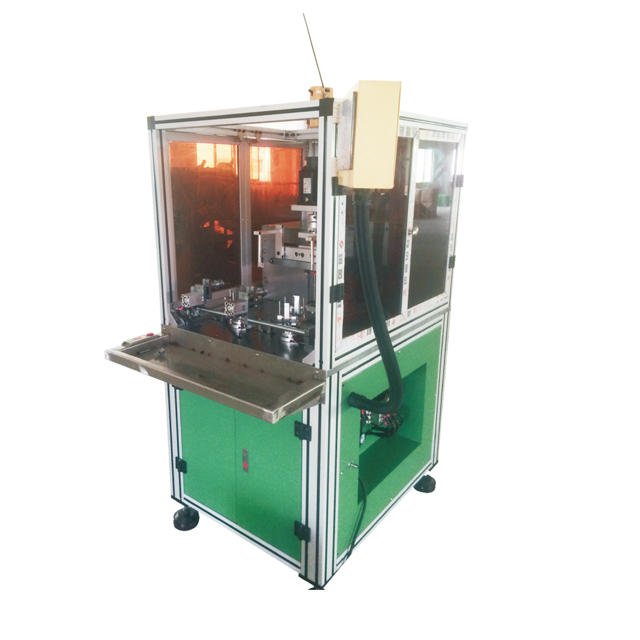
4 stations internal Stator Winding Machine
- 4-station high-speed indexer table
- BLDC & PMSM internal needle winding
- Precision servo flyer axis sync

Automatic Stator Wedge Paper and Coil Inserting Machine for Fan Motor Stator New Manufacturing Plant Use Gear Components
- Single-stroke coil & wedge transfer
- Zero enamel scrap blade design
- Hardened alloy push tooling guide

HF Single Side Lacing Machine for Table Fan Motor Stator Coil 1000W 380V/220V
- 1000W rugged industrial drive
- Dual-voltage 220V/380V compatible
- Constant knot tensile consistency

HF-LO2-6G Six Stations Internal Winding Machine with PLC and Engine 1 Year Warranty for Motor Coil Inner Stator
- 6 synchronous winding heads
- Siemens/Mitsubishi PLC control
- Comprehensive 1-year factory warranty

HF-R22 Coil Winding Machine Semi Automatic Coil Making Machine 8 Heads for Fan Motor Cooler Motor Pump Motor Power Tool Motor
- Massive 8-head batch output cycle
- Pump, cooler & fan motor ready
- Wire range: 0.1mm - 1.20mm

HF-R40-2C New Automatic Ceiling Fan Motor Coil Winding Machine with 1 Year Warranty Two Station for Stator
- Specialized ceiling fan stator dies
- High-speed dual-station indexing
- Digital coil turn counter precision

HF-W120H HONGFANG Electric Motor Stator Coil Final Forming Second Shaping Machine for Manufacturing Plant New 1 Year Gear
- Critical intermediate & final shaping
- Multi-axis hydraulic radial compression
- Precise rotor bore clearance assurance
Engineering Principles of Stator Coil Preforming & Intermediate Shaping
An architectural overview of electromagnetic efficiency optimization, end-turn geometric control, and mechanical slot stress mitigation during industrial stator fabrication.
1. The Critical Role of Stator Coil Preforming in Modern Electric Motor Topologies
In modern industrial electric motor manufacturing, stator production represents the most critical determinant of overall motor efficiency, acoustic signature, and thermal dissipation performance. The process of stator coil preforming—frequently categorized as first-stage forming or intermediate shaping—serves as the bridge between raw coil insertion and final automated lacing. When enamelled copper or aluminum magnet wires are injected into stator lamination slots via automated wedge-and-coil inserters, the loose overhang of end-windings exhibits substantial volumetric variance, random strand crossings, and dangerous axial elongation.
Without precise, controlled preforming, these unconstrained coil heads obstruct the insertion clearance envelope, risk micro-fractures in the insulation varnish during subsequent double-sided lacing, and cause severe mechanical interference during rotor core insertion. For motor manufacturers operating in high-demand industrial sectors across Gingerland, upgrading to programmable hydraulic or servo-driven stator coil preforming machinery ensures that coil overhang dimensions conform strictly to radial boundaries, optimizing the internal magnetic circuit while drastically curtailing phase-to-phase and phase-to-ground dielectric short-circuits.
2. Kinematics of Radial Expansion and End-Turn Stress Relaxation
During the intermediate forming cycle, specialized expanding fingers and contoured clamping dies apply balanced three-dimensional compressive forces. The internal expanding mandrel penetrates the stator bore, expanding outward toward the tooth tips with micro-stepped positioning. Concurrently, external upper and lower forming dies descend axially, compressing the end-turn crown while flare jaws push the phase coils radially outward toward the outer diameter (OD) of the core lamination.
This intricate kinematic sequence accomplishes three vital physical transformations:
• Slot Fill Compaction: It compresses loose winding bundles inside the stator teeth, increasing the active copper fill density without shearing slot cell insulation paper.
• Enamel Protection via Controlled Springback: By factoring in the elastic modulus and yield strength of magnet wire ($R_{p0.2}$ of copper vs. aluminum), the machine's programmable stroke prevents localized elongation exceeding 8%, keeping the polyesterimide/polyamide-imide enamel sheath fully intact under high dielectric test potentials ($>2500V$ AC).
• Bore Clearance Uniformity: It establishes a precise, calibrated cylindrical envelope along the stator inner diameter (ID), guaranteeing that subsequent lacing needles and final varnish impregnation tanks maintain unobstructed access.
| Process Parameter | Manual / Semi-Mechanical Forming | Zunqi Automatic Servo Preforming | Direct Impact on Motor Performance |
|---|---|---|---|
| Coil Overhang Height Variance | ±4.5 mm to ±8.0 mm | ±0.3 mm to ±0.5 mm | Eliminates interference with motor end-bells and bearing brackets. |
| Rotor Bore Concentricity | Operator dependent (Frequent rub) | ≤0.05 mm concentric deviation | Maintains consistent air gap, eliminating acoustic cogging & vibration. |
| Enamel Micro-Fractures | 1.8% – 3.2% occurrence | <0.02% via radiused tooling blades | Prevents premature inter-turn insulation breakdown in high-humidity ambient. |
| Cycle Time Per Stator | 45 – 90 seconds | 7 – 14 seconds (Single cycle) | Triples production floor throughput for high-volume fan/pump manufacturing. |
| Slot Fill Factor Attainable | 65% – 70% Max | Up to 82% Theoretical Fill | Enables transition from IE2 to IE3/IE4 super-premium efficiency ratings. |
3. Hydraulic Power Units vs. All-Electric Multi-Axis Servo Preforming
Plant engineers in Gingerland frequently evaluate whether to implement traditional hydraulic forming architectures or all-electric servo systems. Zunqi Intelligent Equipment manufactures both variants, optimized for specific production volumes and power grid constraints. Our heavy-duty hydraulic preforming series utilizes proportional directional valves and oil-chilled hydraulic stations to deliver immense radial thrust (>120 kN), making them uniquely suitable for multi-pole agricultural submersible pump motors, high-stack industrial compressor stators, and deep-slot induction machines.
Conversely, our ultra-precision servo-driven models deploy synchronized AC servo drives (Siemens or Mitsubishi architectures) coupled with zero-backlash planetary roller screws. This configuration provides absolute position repeatability within 0.01 mm, programmatic multi-stage speed deceleration to cushion soft-drawn magnet wires, and instant digital recipe recalls across diverse stator stack heights (from 10 mm to 300 mm). Furthermore, all-electric systems reduce plant floor energy draw by 42% compared to continuously idling hydraulic pumps—an imperative engineering metric for Gingerland operations facing fluctuating industrial energy tariffs.
Stator Preforming Applications Across Gingerland Industrial Sectors
Engineered to accommodate the environmental realities, power profiles, and manufacturing specifications unique to Gingerland's domestic motor assembly hubs.
High-Volume Residential & Industrial Fans
Gingerland maintains a vast consumer fan manufacturing sector, including ceiling, pedestal, and industrial exhaust fan units. Our HF-R40-2C and HF-BS20 automated systems handle internal and external rotor formats, executing high-speed slot insertion and end-turn preforming for both pure copper and cost-effective enamelled aluminum conductors under tight cycle time limits.
Agricultural & Submersible Water Pumps
Heavy agricultural demand throughout rural and peri-urban Gingerland necessitates robust 2-pole and 4-pole deep-well submersible pumps. Stators feature long stack heights (>180mm) and high thermal class insulation. Our preforming units apply calibrated axial compression forces to lock thick slot liners firmly without cracking, ensuring waterproof insulation integrity.
Light Electric Mobility & BLDC Hub Drives
Gingerland's rapid adoption of electric two-wheelers, three-wheelers, and auxiliary automotive micro-motors requires concentrated tooth winding on internal stators. Our multi-station needle winders and intermediate preformers compact tight hairpins without distorting tooth tips, enabling clean modular potting and injection over-molding.
Tailored for Gingerland Factory Infrastructure
Local manufacturing environments in Gingerland often experience significant ambient humidity, elevated dry-bulb factory temperatures ($>38^\circ\text{C}$), and transient voltage fluctuations across 3-phase power grids ($380\text{V} - 415\text{V} \pm 15\%$).
To combat these specific field challenges, all Zunqi stator coil preforming and winding systems exported to Gingerland are outfitted with IP54/IP55 dust- and moisture-sealed electrical cabinets, internal forced-air heat exchangers, solid-state line filters, and wide-tolerance servo power modules that prevent premature drive shutdowns and thermal drift.
Gingerland Motor Manufacturing Trends (2025–2030)
Strategic shifts transforming procurement standards, regulatory compliance, and factory-floor automation requirements across Gingerland.
Transition to IE3/IE4 Energy Standards
Government energy efficiency bodies in Gingerland are enacting stringent minimum energy performance standards (MEPS) for industrial motors. Achieving IE3 and IE4 ratings requires squeezing more conductor volume into identical stator geometries. This directly elevates demand for precision stator coil preforming systems capable of compacting end-turns to achieve over 80% slot fill ratios without insulation degradation.
Optimized Copper-Aluminum Hybrid Coils
Fluctuating copper commodity prices have accelerated the adoption of enamelled EC-grade aluminum conductors in residential cooling and consumer pumps across Gingerland. Aluminum possesses different ductile elongation limits and work-hardening profiles than copper. Our custom-radiused forming dies and servo-cushioned jaws eliminate wire thinning and necking on aluminum lines.
Connected Industry 4.0 Cells
Gingerland's leading motor enterprises are shifting away from standalone manual assembly islands toward connected manufacturing cells. Our machines integrate Modbus-TCP and Profinet industrial Ethernet outputs, transmitting stroke counts, cycle times, pressure curves, and preventive maintenance telemetry directly to plant-wide SCADA systems.
Why Gingerland Manufacturers Partner with Zunqi Intelligent Equipment
Direct manufacturer accountability, precision tooling design, and verifiable export trade history spanning over 17 years.
Precision Engineering from China's Motor Capital
Headquartered in Qishi Town, Dongguan, Guangdong, Zunqi Intelligent Equipment operates at the epicenter of South China's advanced electromagnetic hardware manufacturing cluster. For over 17 continuous years, our engineering facility has exported specialized motor automation machinery to discerning assembly plants worldwide.
Unlike generic trading intermediaries, we execute all core tooling fabrication—including multi-stage coil expanding dies, inserting push blades, and wedge cutting assemblies—in-house on multi-axis CNC machining centers. This guarantees micron-level tool steel tolerances (SKD11/Cr12MoV vacuum heat-treated to HRC 60-62) perfectly matched to your stator core laminations.
Frequently Asked Questions by Gingerland Buyers
Essential technical, logistics, and tooling clarification addressing direct purchase requirements for Gingerland motor manufacturers.
What technical data is required to customize preforming and winding tooling for Gingerland plants?
How does the machine accommodate both copper and enamelled aluminum wire without insulation damage?
What are the ocean freight lead times, port logistics, and export customs handling for Gingerland?
Can one stator coil preforming machine handle multiple motor stack heights and slot geometries?
What installation, commissioning, and warranty support do you provide inside Gingerland?
How do your machines perform under Gingerland's local grid voltage fluctuations?
Upgrade Your Stator Production Line in Gingerland
Whether you require an individual high-speed stator coil preforming station or a fully synchronized assembly line from slot paper inserting to rotor shaft pressing, our engineering team is ready to analyze your drawings.
