Industrial Stator & Rotor Production Equipment
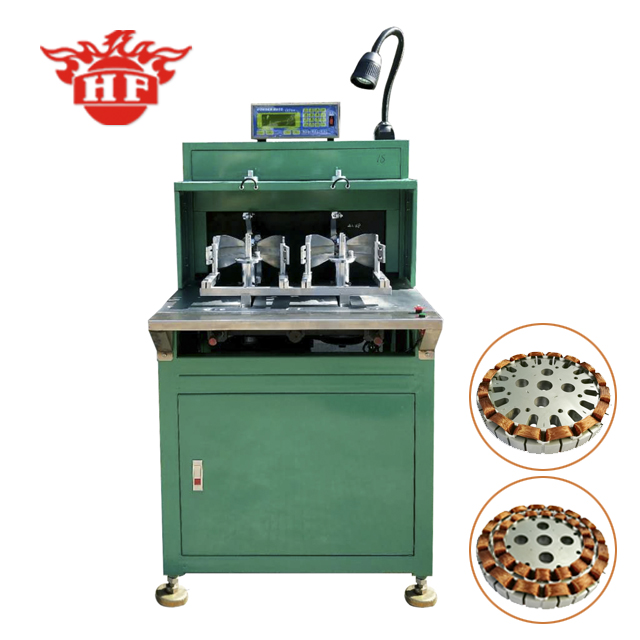
Automatic Two Station Ceiling Fan Winding Machine

Automatic Rotor Fine Turning & Surface Cutting Machine HF-C60

Hydraulic Ceiling Fan Motor Stator Shaft Inserting Press

HF-R40-2C Automatic Ceiling Fan Motor Coil Winding Machine

Automatic Stator Wedge Paper and Coil Inserting Machine

Fully Automatic High-Speed Motor Coil Winding Machine

SC45 Low Carbon Steel Fan Motor Shaft Machining Components

HF Fan Motor Rotor Turning & Surface Cutting Machine
1. Technical Deep-Dive: Next-Generation Stator Coil & Wedge Insertion Automation
In modern electromagnetic component manufacturing, the winding and insertion cycle represents the most critical determinant of total motor operational efficiency and service life. The automatic stator wedge paper and coil inserting system addresses fundamental mechanical constraints that standard manual or semi-automated operations fail to overcome. By orchestrating multi-axis servo systems with high-precision cam profiles, our machines achieve simultaneous transfer of both enamelled phase windings and pre-cut slot insulation wedges into the core slots in a single uniform stroke.
This single-stroke execution drastically minimizes interlaminar shear forces and friction contact against the edges of electrical steel laminations. Standard manual insertion practices invariably risk partial rupture or micro-cracking of the dielectric enamel insulation on the magnet wire, causing high-potential (Hi-Pot) failures or premature inter-turn short circuits under inverter-duty stress. Through our optimized wedge guide tracks and hardened tool steel pushers, wire tension is balanced dynamically, ensuring slot fill factors exceeding 75% without compromising mechanical integrity.
Zero Dielectric Abrasion
Guided insertion mechanics isolate individual copper passes from lamination burrs, completely preserving polyimide and polyesterimide outer coats during heavy fill-factor operations.
Single-Stroke Efficiency
Simultaneous coil grouping and wedge driving curtails station dwell-time down to under 8-15 seconds per stator core, accelerating automated cellular manufacturing throughput.
Custom Tool Geometry
Tooling plates, guide fingers, and wedge pushers are micro-machined to exact customer stator laminations, accommodating non-standard skew angles and specialized slot openings.
2. Mogilev Industrial Ecosystem: Strategic Applications & Manufacturing Context
Mogilev represents one of Eastern Europe's most enduring and concentrated clusters of mechanical engineering, heavy equipment manufacturing, and industrial drive production. Historically reinforced by enterprise infrastructure like Mogilevtransmash and regional electrical appliance hubs, the area possesses deep technical competencies alongside an urgent modern imperative: transitioning legacy production facilities toward fully automated, high-precision manufacturing cells.
The operational landscape across industrial enterprises in the Mogilev Region demands continuous adaptation to European and international electrical machinery standards. Stator coil inserting machinery deployed here must meet rigorous requirements across several defined manufacturing niches:
Agricultural Machinery Auxiliary Motors & Actuators
Modern harvesters, seeders, and transport implements manufactured in Belarus rely heavily on auxiliary fractional and integral horsepower electric drives. These motors operate under extreme environmental constraints, including wide temperature swings (-30°C to +40°C), vibration, and high ambient moisture. Stator winding equipment tailored for Mogilev manufacturers guarantees exact end-turn tightness, uniform geometric clearances, and rugged slot liners resistant to mechanical shock.
Industrial Hydraulic & Chemical Pumping Units
The dense presence of chemical manufacturing and heavy processing machinery in the Mogilev Free Enterprise Zone necessitates heavy-duty induction motors capable of continuous, non-stop operation. Automated coil inserting systems handle multi-wire parallel windings with high thermal ratings (Class F and Class H insulation), ensuring zero voids or cross-overs within the stator slot channels that could cause local hotspots or premature winding breakdown.
Consumer HVAC & Domestic Ventilation Production
Mogilev-based sub-assembly plants focused on domestic appliances and commercial HVAC fans require rapid changeover tooling. Equipment like the HF-R40-2C and HF-C60 rotor finishing systems enable line engineers to balance consumer product margins via low energy consumption, fast turnaround times, and high volume repeatability.
3. Modernization Trends in the Mogilev Electrical Engineering Sector
As the industrial sector across Mogilev and neighboring Belarusian manufacturing corridors contends with rising energy overheads and changing supply chains, three distinct technological shifts are transforming equipment acquisition strategies:
Adoption of IE3/IE4 Efficiency Mandates
Regional manufacturers are aligning with strict international motor energy efficiency standards (IE3 Premium and IE4 Super Premium). Meeting these targets mandates higher slot fill factors (over 75%) and lower end-winding copper overhang, requiring servo-controlled insertion machines that fit dense conductor bundles into compact lamination packages without conductor deformation.
Autonomous Industrial Cells & Traceability
Mogilev engineering managers are migrating away from fragmented stand-alone workstations toward integrated automation lines. Standardized PLC architectures—such as Siemens, Omron, or Mitsubishi—facilitate seamless connectivity with line-level SCADA networks, recording precise winding tension, insertion force graphs, and cycle times for comprehensive quality validation.
Replacement of Manual End-Winding Finishing
Manual lacing and pneumatic press-forming are rapidly giving way to servo-driven double-sided lacing machines and precise hydraulic forming stations. This automation eliminates human fatigue variance, standardizes end-turn dimensions, and guarantees that rotor-to-stator air gaps remain perfectly clear across massive multi-shift manufacturing batches.
4. Procurement FAQ: Sourcing Equipment for Mogilev Operations
What parameters are required to build custom inserting tooling for our stators?
Can the machine electrical cabinets comply with local Belarusian industrial power systems?
How does the automated inserter handle both copper and aluminum magnet wire?
What is the minimum order quantity (MOQ) and production lead time?
How do you handle technical commissioning, training, and ongoing technical support in Mogilev?
What protective packaging is utilized to prevent marine or transit corrosion during shipment to Belarus?
5. Enterprise Advantages & Manufacturing Pedigree
Operating from Qishi Town, Dongguan—within one of China's most advanced manufacturing belts—Zunqi Intelligent Equipment Co., Ltd. serves as a premier developer and global exporter of high-precision electric motor assembly machinery. For over 17 continuous years, our engineering team has designed, refined, and deployed turnkey winding, insulation, insertion, forming, lacing, and rotor-machining solutions across global industrial sectors.
Full Line Turnkey Coordination
We eliminate integration conflicts between standalone machines. Our slot paper inserters, coil winders, coil inserting units, hydraulic intermediate formers, and lacing systems operate with standardized cycle timing and harmonized fixture dimensions.
Open Architecture Industrial Automation
Clients can designate their preferred control architecture—Siemens, Mitsubishi, Delta, Inovance, Omron, or Schneider. Pneumatics are configured using genuine SMC or Airtac components, ensuring immediate interchangeability with existing spare parts inventories.
Strict Onsite Quality Verification
Our operational headquarters and assembly facilities have undergone rigorous onsite third-party audits. Every customer project is rigorously dry-cycled and test-run with actual customer lamination and magnet wire samples before final crating and dispatch.
