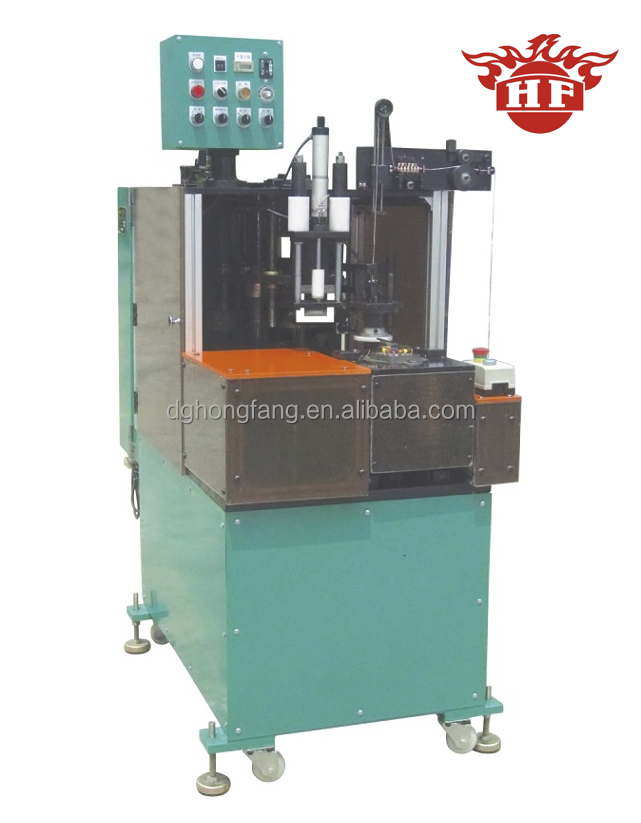
Servo Lacing
HF-BS20 Servo Automatic Double Side Coil Lacing Machine
1000W 220V dual-end simultaneous lacing with adjustable needle tensioning to secure end turns post-forming.
Tailored for industrial electric motor rewinders, precision HVAC lines, medical motion controls, and e-mobility Tier-2 parts manufacturers across Heredia Province and greater Costa Rica Free Zones.
1000W 220V dual-end simultaneous lacing with adjustable needle tensioning to secure end turns post-forming.

Integrated PLC control and precision coolant pump ensuring micro-tolerance aluminum OD surface cutting.

Automated edge-folding, cutting, and high-speed slot cell liner insertion for cooler and fractional motors.

Six-station multi-spindle automatic winding built for brushless inner stator configurations with synchronized indexing.

Specialized flyer head system for external stator slots, drone hubs, stepper motors, and specialized transformer packages.

Rigid steel frame press with tonnage-governed insertion preventing core stack delamination and shaft runout.

Twin workstation engineering with dual independent CNC controllers for continuous production without load lag.

Adaptive tension servo winding capable of handling soft-annealed copper and light-gauge enameled aluminum wire.
In electric machine manufacturing, electromagnetic efficiency, thermal dissipation, and copper fill factor depend directly on the mechanical precision of the coil end turns. Stator coil forming machines—comprising intermediate expanders, radial clamp compactors, and 3D CNC hydraulic/servo final formers—are the bridge between preliminary coil insertion and final resin impregnation. In regional manufacturing clusters such as Heredia, Costa Rica, where cleanroom assembly and high-specification electro-mechanical production are standard, achieving absolute geometric repeatability without damaging enamel insulation is critical.
When magnet wire (Grade 1 or Grade 2 modified polyester with polyamide-imide topcoat) is inserted into the lamination stack, coils emerge unorganized and bulging outward. If uncorrected, end-turns will physically collide with the motor cast-iron frame or block the rotor cavity during final rotor insertion. Furthermore, poor forming leads to phase-to-phase insulation friction, creating partial discharge pathways and early breakdown under variable frequency drive (VFD) switching surges.
Prior to coil lacing, an expandable internal expansion mandrel drops through the stator bore. Mechanically actuated expanders flare out the inner circumference of the coil overhang, clearing clearance channels for automatic needles on machines like the HF-BS20.
Hydraulically synchronized or multi-axis servo clamping segments compress the outer diameter of the coil heads inwards. This controls maximum coil extension tolerances, vital for hermetic compressor assemblies and compact pump stator shells.
Upper and lower forming dies descend with calibrated tonnage limits, compressing coil head axial height to sub-millimeter limits without crushing the phase separation Nomex sheets or cracking wedge retainers.
Heredia has cemented its reputation as the engine room of high-technology manufacturing and advanced services within Central America. Supported by top-tier parks such as UltraPark Free Zone, Global Park, AFZ (América Free Zone), and nearby industrial corridors like El Coyol, facilities are transforming from basic electromechanical subassembly to sophisticated, high-reliability component production. The demand for automated stator winding, insulation paper inserting, and precise coil forming machinery across the Heredia industrial landscape centers on distinct high-value verticals:
With Costa Rica being a global exporter of Class II and III medical devices, Heredia contract manufacturers build high-frequency surgical tool actuators, micro-pumps, and dental micro-motors. These sub-fractional stators require delicate wire forming without particulate generation.
The regional food processing, coffee processing, and dairy plants around San Rafael, Belén, and Barva rely on continuous-duty, high-ingress protection submersible pumps and ventilation blowers. Stators require dense wire slots and rugged lacing to endure humid conditions.
Costa Rica's National Decarbonization Plan prioritizes industrial electrification. Heredia assembly contractors are adopting multi-station winding (such as the HF-LO2-6G) and heavy hydraulic coil formers for light electric vehicles, golf carts, and solar water pumps.
In each scenario, manual hammering and hand-mallet wooden block shaping are unacceptable. Manual methods create micro-fractures in the magnet wire coating that result in motor failure within months of operational stress. Automated stator coil forming machines ensure uniform heat distribution, eliminate air pockets that impede varnishing, and guarantee that every stator leaving Heredia meets strict ISO 9001 and UL certification standards.
Selecting the optimal equipment configuration requires matching stack heights, wire gauges, and cycle time demands. Below is the technical reference matrix for engineering teams configuring manufacturing plants in Heredia and Central America:
| Machine Process Series | Core Application | Stack Height (mm) | Max Stator OD (mm) | Control & Drive System | Tact Time (Per Stator) |
|---|---|---|---|---|---|
| Hydraulic Final Forming | Fractional & Induction Pump Motors | 10 – 250 mm | Φ 200 mm | Siemens / Mitsubishi PLC + Dual Cylinder | 7 – 12 Seconds |
| Servo Double-End Lacing (HF-BS20) | Ceiling, Table & Shaded Pole Fans | 8 – 70 mm | Φ 160 mm | Multi-axis Servo Synchronization (220V) | ≤ 14 Seconds |
| Paper Insertion (HF-D50) | Cooler, Condenser & Appliance Motors | 15 – 120 mm | Φ 180 mm | Stepper / Pneumatic Auto Feeder & Creaser | 0.5 – 0.8 Sec / Slot |
| Internal Winder (HF-LO2-6G) | Brushless DC, Servo & 3-Phase Motors | 10 – 90 mm | Φ 120 mm | 6-Station Multi-Spindle High-Speed PLC | Multi-station parallel |
| Rotor Turning Machine (HF-C60) | Precision Squirrel-Cage OD Finishing | Customized Shafts | Φ 150 mm | Automatic Lathe Core with Coolant Pump | 10 – 18 Seconds |
| Hydraulic Shaft Pressing | Rotor-to-Shaft Interference Pressing | Up to 300 mm Shafts | Tonnage 5T – 20T | Dual Push-Button Safety + Pressure Sensor | 5 – 8 Seconds |
*Note: Tooling blocks, expanding blades, and guide shoes are modular. Our Dongguan tooling lab fabricates custom steel sets based on client DXF/STEP CAD drawings before export to Costa Rica.
The manufacturing sector in Costa Rica is undergoing a rapid transition toward digital telemetry, zero-carbon manufacturing, and high-efficiency motor standards (IE3 and IE4 Super Premium Efficiency). Several key technological shifts directly impact how manufacturers in Heredia select stator coil processing equipment:
Premium efficiency motors require copper slot fill ratios exceeding 78%. Inserting such dense coil bundles without wedging failures demands progressive forming where intermediate dies open up copper channels without scuffing the magnetic wire insulation.
With North American OEMs seeking supply resilience outside Asia, Costa Rica Free Trade Zone (FTZ) regimes offer tax incentives that draw automated lines. Turnkey machine cells must deliver European-grade repeatability at high capital payback speed.
Unlike mega-factories focused on one frame size, Heredia contract plants handle high-mix medium-volume runs. Tooling quick-change features (sub-20 minute changeouts for upper/lower dies and expanders) have become a primary purchasing condition.
Headquartered in Qishi Town, Dongguan, Zunqi Intelligent Equipment operates at the epicenter of precision machine tool engineering. With over 17 years of verified global export performance, our manufacturing facility delivers end-to-end motor automation systems designed to integrate with your shop-floor systems.
We do not supply off-the-shelf, ill-fitting dies. Every coil forming former, expander, and insertion finger is CNC milled from Cr12MoV vacuum-quenched alloy steel tailored to your exact lamination CAD drawings.
We standardize on universally serviceable industrial automation hardware: Siemens, Mitsubishi, Delta PLCs; Schneider electric switchgear; and SMC/Airtac pneumatics, ensuring maintenance staff in Costa Rica can source local spares without friction.
Before crating, clients provide physical stator packs and magnet wire samples. We execute a comprehensive run-off test, logging cycle time, dielectric surge testing, and dimensional compliance via high-definition video acceptance.
Common questions asked by manufacturing plant directors, tooling specialists, and import managers in Costa Rica regarding electric motor automation procurement:
While standard Asian industrial lines operate on 380V 50Hz, Costa Rica runs predominantly on a 60Hz grid with standard industrial voltages of 208V/220V/240V three-phase or 480V three-phase, alongside 120V/240V single-phase systems. Before production, our electrical engineers customize the machine's primary transformers, servo drives, and PLC power supplies to match your facility's exact electrical drop (e.g., 220V 3-Phase 60Hz or 480V 60Hz), eliminating the need for bulky external step-down transformers on your plant floor.
Standard machines (such as single/double station winders and hydraulic coil formers) require 25 to 35 business days for precision tooling fabrication, assembly, and trial run-offs. Ocean freight containers are dispatched from Shenzhen or Guangzhou ports directly through the Panama Canal to Puerto Limón on the Caribbean coast (approximately 24 to 28 days transit), or alternatively to Puerto Caldera on the Pacific coast. From either port, bonded bonded-trucking provides rapid transfer into Heredia's Free Trade Zone warehouses.
Yes. Factory Acceptance Testing (FAT) is standard procedure. We encourage customers to courier a batch of 5 to 10 un-wound stator lamination stacks and preferred magnet wire to our Dongguan facility. We test the complete toolpath, film microscopic cross-sections of the coil heads post-forming, check for phase-to-phase shorts with a surge tester, and deliver an unbroken 4K video log along with a CMM dimensional verification report before authorizing dispatch.
Our stator coil forming machines use multi-segmented expanding fingers and forming dies manufactured from high-grade alloy steel polished to a mirror finish (Ra ≤ 0.2 μm) and treated with specialized hard chrome or DLC coating. The pneumatic/hydraulic expansion speeds are programmable in multiple velocity stages: rapid approach, slow progressive compression with dwell time, and controlled retraction. This prevents friction-induced thermal scuffing of the enamel coating.
Every export shipment includes a 1-year operational consumables kit: replacement forming segment return springs, limit switches, pneumatic seals, high-wear lacing needles, and wire guides. Furthermore, because we standardize on global automation components (Siemens, Delta, Mitsubishi, Schneider, SMC), non-proprietary electrical and pneumatic parts can be sourced locally in San José/Heredia industrial supply houses when immediate replacement is necessary.
We provide comprehensive commercial documentation conforming to Costa Rican customs (PROCOMER / DGA) requirements for Free Trade Zone duty-free capital equipment entry. This includes customized Commercial Invoices with correct HS Codes (typically 8479.81 or 8479.89), Detailed Packing Lists with wood packaging ISPM-15 fumigation certificates, Bill of Lading, and CE Declarations of Conformity alongside dual English/Spanish operation manuals and electrical schematics.
Send your stator core drawings (OD, ID, stack height, slot profile, and wire specs) to our engineering team. We deliver custom tooling simulations, cycle time calculations, and direct factory pricing within 9 hours.
