Dual Station

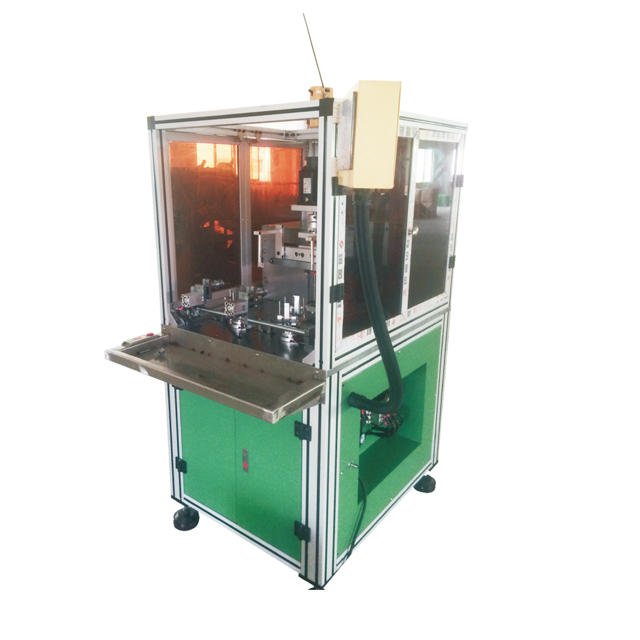
Stator Winding Machine 2 Station Outernal Winding Machine for Transformer Motor
Outer Winding
PLC Drive
High Tension
Engineered to deliver high coil compaction ratios, uniform air gaps, and Class H dielectric reliability for heavy-duty drive systems and high-throughput production lines.






Why intermediate and final forming operations are the decisive factor in motor dielectric survival under variable frequency drive (VFD) switching harmonics and high-vibration mining regimes.
After automatic coil and wedge insertion, wire crossovers create localized pressure peaks and asymmetric end-turn overhangs. Our hydraulic expanding tooling simultaneously forces inner mandrels outward while axial clamping shoes push inwards, consolidating copper bundle geometry without micro-fracturing magnet wire enamel.
Variable frequency inverter drives (such as those widely used in flotation cell agitators and slurry pump motors) produce repetitive steep-fronted voltage transients (high dV/dt). Non-uniform coil spacing triggers partial discharge (corona) phenomena. Final forming establishes controlled inter-phase clearance.
In heavy slurry pumping and mineral screening, continuous harmonic vibrations exert mechanical fatigue upon overhang coils. Mechanically formed and servo-laced end-windings eliminate wire bundle whipping, preventing turn-to-turn abrasion and preventing insulation rupture before varnish cure.
| Stator Parameter | Standard Commercial Motor | Antofagasta Severe-Duty Mining Specification | Zunqi Machine Precision Guarantee |
|---|---|---|---|
| End-Turn Overhang Tolerance | ± 3.5 mm | ± 0.8 mm (Strict Enclosure Allowance) | ± 0.35 mm (Servo Controlled) |
| Phase Insulation Creepage | > 6.0 mm (Air) | > 12.5 mm (Altitude Derated to 3,000m+) | Configured via Custom Step Dies |
| Slot Wedge Compaction | Manual Drift Pin | Mechanical Hydraulic Insertion & Locking | 100% Retentive Positive Lock |
| Inter-Coil Mechanical Air Gap | Random Clearance | Uniform Radial Duct Clearance | Calibrated Expanding Segment Dies |
Supplying rebuild centers, electrical mechanical workshops, and motor assembly facilities operating across the Atacama industrial corridor—from Puerto Coloso to high-altitude copper concentrators.
Mines surrounding Antofagasta, Calama, and the high cordillera experience reduced atmospheric air density. Motors suffer diminished convection cooling and accelerated corona breakdown due to Paschen's Law. Our stator coil forming machinery compresses slot overhang loops into aerodynamically clean contours that maximize internal forced air and prevent dust accumulation.
Seawater intake facilities near the Port of Mejillones and Antofagasta utilize large submersible pumps and high-pressure reverse osmosis booster systems. These drive units require extreme insulation integrity. Final forming dies prevent the kinking of heavy Nomex/polyester slot liners, eliminating pinhole leakage paths that permit conductive salt-spray moisture ingress.
Ball mills, SAG mills, and high-rate thickeners impose severe low-speed, high-torque torsional stresses on electric motors. Our stator coil forming lines accommodate heavy rectangular-wire configurations as well as multi-strand round wire bundles, delivering tight physical packing factors that eliminate inter-strand friction under pulsating torque loads.
How regulatory decarbonization mandates, the Chilean National Mining Policy 2050, and electrification are forcing a transition from manual motor rewinds to automated forming precision.
Chile's SEC (Superintendencia de Electricidad y Combustibles) has instituted stringent minimum energy performance standards (MEPS) for industrial three-phase induction motors. Meeting IE3 and IE4 efficiency thresholds leaves no tolerance for copper fill volume loss or distorted slot winding heads. Automated stator final forming achieves up to a 78% slot copper packing factor without enamel thinning.
Traditional repair workshops across Antofagasta historically relied on manual mallets and wooden levers to form stator end-windings—a practice causing microscopic copper work hardening and early ground faults. Modern workshops are retrofitting automated hydraulic and servo-electric final formers to satisfy ISO 9001 and EASA AR100 repair audits required by Tier-1 mining operators.
Supply chain lead times from European and North American OEMs for bespoke heavy mining motors can exceed 40 weeks. Regional facilities in Antofagasta are establishing dedicated winding lines to assemble and re-manufacture stators locally. Zunqi provides flexible tooling setups capable of handling diverse frame sizes (IEC 80 up to IEC 355) on a single versatile forming chassis.
How Zunqi Intelligent Equipment validates every custom stator final forming unit before crating for trans-Pacific shipment to Antofagasta ports.
Engineers analyze your stator lamination drawings (OD, ID, stack height, slot profile, and overhang restrictions) via 3D CAD to formulate custom multi-jaw expanding tool geometries.
Forming shoes, mandrel teeth, and wedge pushers are machined from Cr12MoV vacuum-quenched die steel (HRC 58-62) and mirror-polished to prevent magnet wire scuffing.
Installation of high-pressure dual-circuit hydraulic manifolds or multi-axis servo positioners, engineered with precision pressure transducers for gradual ramping force curves.
Control cabinets are wired according to IEC standards with Siemens, Schneider, Omron, or Delta components, configured specifically for Chilean 380V / 50Hz grid conditions.
We wind, insert, and form actual client-supplied stator samples in our Dongguan workshop, recording real-time stroke pressure, cycle durations, and final coil dimensions.
Formed stators undergo dielectric hipot testing (2.5kV+), inter-turn surge comparison, and phase resistance validation to confirm 100% wire insulation retention after compression.
High-resolution operational video, digital coordinate measurement (CMM) reports, and PLC parameters are provided to your Antofagasta engineering team for pre-shipment signoff.
VCI vapor-corrosion inhibiting film wrap, thick desiccants, machine skid bolting, and ISPM 15 heat-treated plywood casing ensure complete protection against maritime humidity.
Direct factory advantages from our Dongguan automation facility, combining custom toolmaking precision with world-class engineering governance.
Unlike third-party equipment traders, Zunqi designs, casts, and mills all winding mandrels, inserting blades, and coil forming shoes internally. Every radius is calculated directly from your motor's core slot dimensions and copper fill percentages, ensuring flawless repeatability.
We supply fully matched equipment families: from automatic slot paper insulaters and high-speed coil winders, to combined coil & wedge inserters, intermediate formers, double-sided servo lacers, and final formers. All systems utilize compatible cycle times and standardized PLC interfaces.
With 17 years on international B2B directories and on-site verified production workshops, Zunqi provides complete transparency. We deliver remote real-time video commissioning, multilingual software interfaces (English/Spanish parameter screens), and guarantee spare wear parts availability for 10+ years.
Comprehensive answers regarding electrical compatibility, maritime logistics, customs clearance, and tooling flexibility for Northern Chile operations.
Yes, absolutely. While China typically operates at 50Hz with 380V or 220V, and other South American nations use 60Hz, we specifically configure all motors, hydraulic power units, servo power supplies, and PLC transformer circuits to match Chile's standard 3-phase 380V 50Hz (or single-phase 220V 50Hz) industrial supply. Electrical components carry CE and UL-recognized marks, ensuring complete compliance with Chilean SEC standards.
We routinely ship CIF or CFR to the Port of Antofagasta (CLANF) or Puerto Angamos / Mejillones (CLMJS). Every machine is vacuum sealed in protective VCI barrier film, equipped with humidity indicators, and bolted within an ISPM 15 certified solid plywood crate suitable for ocean transit. We provide complete commercial invoices, packing lists with Harmonized Tariff codes (HS Code 8479.81 / 8479.89), and Certificate of Origin documents (Form F under the China-Chile Free Trade Agreement) enabling duty-free or preferential tariff clearance.
Yes. Our forming machines are engineered with quick-change modular tooling. By swapping out the upper forming head, central expanding mandrel segments, and bottom locator plate (a process requiring approximately 20 to 35 minutes), a single machine can process a broad family of stator dimensions. For repair and rewinding facilities servicing diverse mining motors, we provide adjustable universal forming plates that accommodate various stack heights and coil diameters without requiring dedicated steel for every single motor model.
Zero wire damage is our strict engineering benchmark. Enamel scuffing during final forming occurs when tooling edges have micro-burrs or when hydraulic force ramps too abruptly. Our forming dies are precision CNC-machined from hardened Cr12MoV tool steel, vacuum heat-treated, and hand-lapped to an Ra < 0.2 μm mirror finish. Furthermore, the PLC allows dual-stage forming: an initial gentle pre-positioning stroke followed by controlled high-tonnage consolidation, allowing copper bundles to yield naturally without pinching.
Every machine ships pre-programmed, calibrated, and fully documented with English and Spanish HMI touch screens. We supply comprehensive digital operating manuals, circuit schematics, and step-by-step video tutorials. Following machine uncrating in Antofagasta, our senior application engineers conduct live video-guided commissioning sessions to assist your maintenance team with wire threading, pressure calibration, and parameter optimization. Spare consumable parts (springs, seals, blade inserts) are readily dispatchable via DHL/FedEx air freight within 24 hours.
To configure your forming tooling with micron-level accuracy, please furnish: (1) Stator lamination outer diameter (OD) and inner bore diameter (ID); (2) Lamination core stack height range; (3) Stator slot count and cross-sectional drawing; (4) Magnet wire diameter and number of parallel conductors per slot; (5) Maximum allowable coil end-turn overhang height and radial thickness from the motor housing blueprint. If available, sending one physical stator core or unvarnished wound sample guarantees 100% verified tooling fit prior to ocean dispatch.
Whether you are establishing a high-efficiency motor manufacturing facility or upgrading an electro-mechanical mining service shop, our engineering specialists will configure the exact tooling and hydraulic pressure profile for your stator portfolio within 9 hours.
Send an Inquiry