Engineered Stator Manufacturing & Insulation Machinery
Factory-direct automation equipment precision-matched to your lamination profiles, slot geometry, and production throughput targets.

HF Single Side Lacing Machine for Table Fan Motor Stator Coil
- Power: 1000W | 380V/220V Configurable
- High-tensile vibration-proof binding
- Automated indexing and tension brake

HF-R40-2C New Automatic Ceiling Fan Motor Coil Winding Machine
- Dual-station simultaneous winding
- Dedicated to fan stator core geometries
- 1 Year factory warranty & spares kit

HF-R22 Semi-Automatic Coil Making Machine (8 Heads)
- 8-head concurrent coil formation
- Applicable for cooler, pump & power tools
- Copper & aluminium enameled wire ready

Six-Station Outer Stator Motor Coil Winding Machine
- Continuous automatic turret rotation
- Microprocessor PLC system integration
- Heavy-duty gearing for industrial cycles

HONGFANG HF-D50 Green Insulation Paper Insertion Machine
- Automated cuffing, folding, shearing & pushing
- Cycle time: ~0.5s to 0.8s per slot cell
- Compatible with DMD, NMN, Nomex & Mylar

Automatic Servo System Stator Coil & Wedge Inserting Machine
- Simultaneous coil & closure wedge insertion
- Multi-axis servo-driven pushing fingers
- Prevents magnet wire scratching and deformation

Fully Automatic Fan Motor Coil Winding Machine
- Automatic flyer winding and indexing
- Handles 0.1mm - 1.2mm wire diameters
- CE-compliant guarding and interlock safety
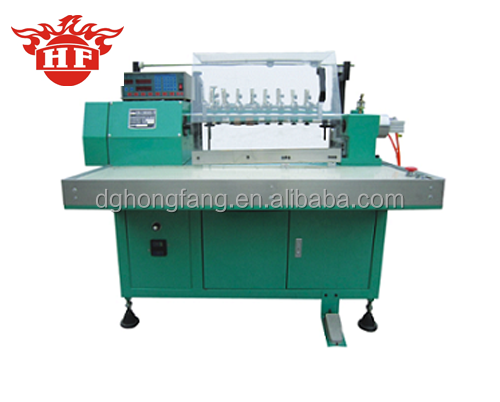
HF New CNC Auto Stator Coil Winding Machine (8 Heads)
- 3000 RPM precision spindle rotation
- Programmable turns, pitch & deceleration
- Suitable for high-volume series manufacture
Dielectric Integrity & Kinematics in Motor Stator Slot Insulation
In modern alternating current (AC) induction motors, permanent magnet synchronous motors (PMSM), and brushless DC (BLDC) units, the stator slot insulation paper serves as the primary dielectric boundary between conductive copper magnet wires and grounded silicon steel laminations. Failure within this microscopic barrier—often no thicker than 0.15mm to 0.35mm—leads inevitably to inter-turn short circuits, localized partial discharges, and catastrophic stator ground faults.
Manual insertion methods suffer from acute human inconsistency: uneven cuffing, incomplete cell seating, micro-tearing along the sheared edges, and erratic axial protrusion. When copper conductors are automatically inserted or pulled during the subsequent winding phase, unaligned paper edges wrinkle or fold backward. This exposes bare punch-burr lamination edges to enameled magnet wire insulation, causing micro-abrasions that degrade during thermal cycling.
Our Automatic Motor Insulation Paper Inserting Machines resolve these physical failure modes through synchronized servo-kinematics. By mechanizing paper coil decoiling, bidirectional edge cuffing, precise feed metering, high-hardness alloy shearing, form-creasing, and rapid pneumatic/mechanical pushing, the machine achieves dimensional repeatability within ±0.05mm. The resulting insulating barrier conforms uniformly to the stator tooth flanks, maximizing slot fill factor while guaranteeing strict dielectric protection up to Class H (180°C) thermal ratings.
Dielectric Material Processing Capabilities
DMD Laminates
Polyester film with non-woven polyester fabric backing; optimal balance of dielectric rigidity and puncture resistance.
Nomex® & NMN
Aramid paper/polyimide composite films engineered for demanding Class F and Class H thermal stresses in industrial pumps.
Mylar® (PET Film)
Cost-effective Class B insulation for consumer appliance stators, providing high mechanical strength and thermal resistance.
Fishpaper & Vulcanized Fiber
Traditional high-density cellulose composite slot liners for robust mechanical isolation in heavy rewinding setups.
Benchmarking Stator Slot Insulation Processes
Comparative operational analysis illustrating quality metrics, production cycles, and reject rates across industrial stator manufacturing methods.
| Evaluation Parameter | Manual Insertion & Cutting | Semi-Automatic Mechanical Inserter | Zunqi Automatic Servo Slot Inserter |
|---|---|---|---|
| Cycle Time (36-Slot Stator) | 180 – 300 seconds | 45 – 65 seconds | 18 – 25 seconds (~0.5s/slot) |
| Cuff Width Consistency | ±1.50 mm (Subject to operator drift) | ±0.35 mm (Cam-linkage dependent) | ±0.05 mm (Servo feed + micro-micrometer) |
| Slot Cell Edge Tearing Risk | Elevated (Manual shearing & creasing) | Moderate (Fixed blade wear) | Zero (Tungsten carbide precision dies) |
| Partial Discharge Rejection Rate | 3.8% – 6.5% during Hi-Pot test | 0.9% – 1.8% average | < 0.08% consistently |
| Lamination Stack Height Range | Unrestricted but uneven | 10 mm – 150 mm (Requires tool swap) | 10 mm – 220 mm (Stepless HMI input) |
| Labor Overhead per 10,000 Units | ~480 Man-hours | ~120 Man-hours | ~15 Man-hours (Operator loading only) |
Localized Deployment: Powering Pristina's Electromechanical Renaissance
The manufacturing sector in Pristina, together with surrounding industrial corridors such as Fushë Kosovë, Ferizaj, and the northern mining basins of Trepça, is undergoing rapid technological modernization. Historically reliant on localized repair workshops, manual motor rewinding operations, and imported pre-assembled electric motors from Western Europe or Turkey, regional industrial leaders are increasingly transitioning toward domestic fabrication, value-added assembly, and precision aftermarket retrofitting.
Several structural drivers make the deployment of high-performance stator slot paper inserting machinery vital for Pristina's manufacturing ecosystem:
HVAC & Ventilation Dynamics
Commercial construction in Pristina demands localized fabrication of quiet, high-efficiency blowers and centrifugal HVAC fan motors. Manual paper insertion generates irregular slot margins that cause coil asymmetry and acoustic whine. Our automated machines ensure balanced magnetic circuits with acoustic dampening.
Mining & Heavy Slurry Pumps
Industrial extraction in Kosovo's mineral sector subjects submersible pump stators to continuous moisture and vibration. By inserting multi-layer aramid (Nomex®) papers with uniform folded cuffs, our insertion systems eliminate high-voltage ground tracking and motor burnout in hostile underground setups.
CEFTA & EU Export Compliance
Kosovo-based electromechanical exporters targeting the European Union must meet stringent CE, IEC 60034-1, and Low Voltage Directives (LVD). Automated dielectric cell insertion guarantees predictable insulation resistance (>100 MΩ at 1000V DC) across full-volume production runs.
Infrastructure & Supply Chain Integration in Kosovo
Industrial installations in the Pristina district operate on standard 400V 3-phase (±10%) and 230V single-phase 50Hz electrical supply. Zunqi machines are configured with robust EMC filters and industrial transformers that insulate sensitive PLC microprocessors and servo drives against regional grid fluctuations. Furthermore, machine frames are treated with anti-corrosive multi-layer coatings to withstand winter warehouse condensation typical of the continental Balkan climate.
Logistically, shipments destined for Pristina are routed via sea freight through the deepwater Adriatic ports of Durrës (Albania) or Aegean terminals in Thessaloniki (Greece), followed by bonded overland transit along the R7 Highway directly into Pristina customs terminals. All machines arrive packed in fumigation-free, steel-banded plywood shipping cases equipped with desiccants and moisture-barrier VCI foils to ensure zero oxidation during maritime and road conveyance.
Kinematic Architecture of Zunqi Insertion Machines
An overview of the continuous, mechanical and electronic stages executed within 600 milliseconds per slot cell.
Stage 1: Tensioned Decoiling & Edge Cuffing
The raw insulation roll is unspooled under constant magnetic particle tension. Heated or cold mechanical rotary fold rollers impart bidirectional edge cuffs (2.5mm to 5.0mm wide) that double the edge thickness, ensuring high mechanical resistance against insertion shear forces.
Stage 2: Precision Metering & Shearing
A high-resolution stepper or servo motor advances the cuffed tape precisely to the programmed lamination stack length. A mirrored pair of tungsten-carbide guillotine blades severs the paper with clean, burr-free perpendicularity, eliminating fiber fraying.
Stage 3: Slot Pre-forming & Core Insertion
Tooling dies press the cut paper into the target cross-sectional shape (U-shape, round-bottom, or square-tapered). A high-speed mechanical transfer pusher drives the formed cell axially into the stator slot, while an optical indexer rotates the core to the subsequent slot.
Why Pristina Motor Engineers Partner with Zunqi
Zunqi Intelligent Equipment Co., Ltd. operates from Qishi Town, Dongguan—the epicenter of world-class precision automation engineering in South China. Backed by 17 years of continuous international exporting, we have engineered dedicated machinery for fractional horsepower fan stators, multi-kilowatt industrial pump motors, hermetic compressor stators, and cutting-edge electric mobility powertrains.
- Bespoke CNC Tooling: Every forming die, insertion blade, and indexing collet is custom CNC-machined to your exact stator drawings.
- Full Line Integration: We deliver harmonized production lines—from slot insulation and coil winding to coil/wedge insertion, forming, lacing, and rotor shaft pressing.
- Global Brand Architecture: Control systems can be configured with Siemens, Mitsubishi, Omron, Delta, or Schneider components for straightforward local maintenance.
- Physical Trial Run Validation: We require your physical stator laminations prior to delivery, shipping only upon your video sign-off of continuous trial runs.
Comprehensive Stator Automation Suite
We manufacture dedicated machines for each sequential stage of the electric motor production process:
Frequently Asked Questions by Industrial Buyers in Pristina
In-depth technical, logistics, and commercial answers for plant managers and procurement directors in Kosovo and the wider region.
Can the insulation paper insertion machine handle irregular or mixed stator slot profiles? +
How does the equipment adapt to Pristina's 400V/230V 50Hz electrical supply standards? +
What are the lead times and shipping corridors from Dongguan to Kosovo? +
What documentation is provided for customs clearance under Kosovo Customs Code? +
How is commissioning and after-sales support managed remotely for facilities in Pristina? +
What minimum maintenance is required to maintain zero-defect insertion over years of service? +
Can one machine handle multiple stator models with different stack heights and diameters? +
Modernize Your Electric Motor Stator Line in Pristina
Send our senior engineering team your stator technical drawings (ID, OD, stack height, and slot cross-section). We will return a comprehensive production analysis, machine recommendation, and formal quotation within 9 hours.
