Core Machinery Lineup for Greek Stator & Rotor Assembly Lines
Seamlessly integrate high-rigidity coil winding, slot inserting, multi-stage forming, and high-speed rotor finishing to match your Hellenic plant specifications.






Motor Coil Lacing Architecture in Greece: Transitioning to Premium Efficiency
Why modern Greek motor OEMs and heavy rewinding repair plants from Piraeus to Sindos are turning to servo-driven automated stator lacing systems.
The electrical motor manufacturing and refurbishment sector in Greece operates at a critical nexus between rigorous European Union efficiency mandates and demanding Mediterranean operating conditions. Under the EU EcoDesign Directive (Regulation EU 2019/1781) and international standard IEC 60034-30-1, electric induction motors deployed across Greece must hit IE3 (Premium Efficiency) and, increasingly, IE4 (Super Premium Efficiency) performance benchmarks. For Greek manufacturers located in industrial hubs such as Attica (Athens, Aspropyrgos), Thessaloniki (Sindos Industrial Area), Patras, and the agricultural plains of Thessaly (Larissa and Volos), reaching these higher energy classes necessitates a total overhaul of the traditional, manual stator lacing process.
In high-efficiency electric motors, magnetic flux density and thermal dissipation are pushed to physical thresholds. Stator laminations utilize thinner silicon steel grades, and winding slots are engineered with fill factors often exceeding 75% to 80%. When coils are manually bound with cord or polyester tape, human inconsistency introduces uneven mechanical tension, variable end-turn flare, and micro-abrasions in the magnet wire enamel. In demanding applications common to Greece—such as high-salinity marine auxiliary pumps at the Piraeus/Perama naval repair yards or continuous deep-well agricultural submersible pumps in Larissa—inadequately laced end-turns succumb rapidly to electrodynamic Lorentz vibrations, harmonic distortion, and thermal degradation, culminating in premature inter-turn phase faults.
By implementing direct CNC servo-controlled motor coil lacing machines, Greek manufacturing plants secure continuous tension regulation (from 5N to 45N), flawless diamond or single-stitch geometric repeatability, and absolute physical immobilization of the coil heads. Whether processing standard IEC frame sizes (IEC 63 up to IEC 280) or custom naval low-noise stators, automated lacing guarantees that the coil heads maintain uniform spatial clearance from the motor end shields, optimizing cooling airflow while completely preventing short-circuit grounds.
Simultaneous Dual-End Servo Lacing
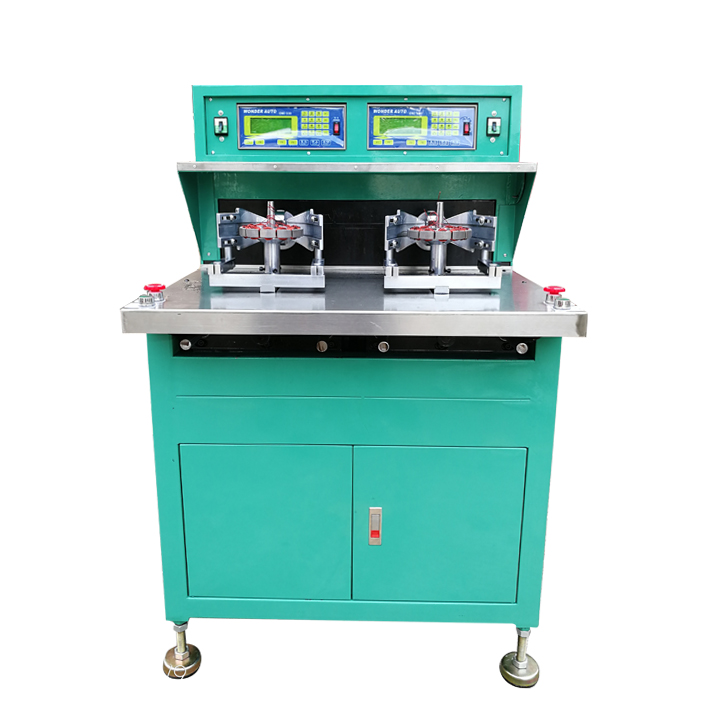
Equipped with dual synchronized servo needles that stitch both the drive-end (DE) and non-drive-end (NDE) of the stator simultaneously, cutting cycle times by over 60% compared to legacy single-end machines.
- Adjustable stitch pitch per slot / skip slot capability
- Servo-synchronized hook and needle trajectories
- Integrated automatic thread cutting and knotting
Dynamic Cord Tension Transducers
Specifically calibrated for high-grade multi-strand braided polyester, polyamide, and Nomex lacing tapes without stretching, fraying, or lacerating Grade 2 enamelled copper wires.
- Closed-loop pneumatic-electric tension stabilization
- Eliminates coil head bulge before final pressing
- Prevents slot insulation paper dislodgement
CE & Greek Grid Electrical Compliance
Engineered for European TN-S and TT grounding distribution topologies (3-Phase 400V / 230V 50Hz) with integrated Schneider or Siemens PLC architectures and EN ISO 13849-1 safety curtains.
- Multi-language HMI (English/Greek technical setup)
- Storage for up to 100 distinctive stator recipes
- EMC Class A filter suppression for marine yards
End-to-End Stator Automation: Matching Equipment to Industrial Specifications
Deploy our integrated stator manufacturing suite tailored to standard Greek motor stack heights, bore diameters, and frame ratings.
| Production Phase | Recommended Machine Series | Dimensional / Tooling Scope | Technical Objective | Greek Industrial Benchmark |
|---|---|---|---|---|
| 1. Slot Lining | Automatic Insulation Paper Inserter | Stator OD: 30–260 mm Stack: Up to 250 mm |
Cuts, forms, and inserts Nomex / DMD / PET liners into every slot with 100% boundary integrity. | Class F / Class H Insulation |
| 2. Primary Winding | 6-Station or Multi-Head Coil Winder | Wire Gauge: 0.10–1.40 mm Up to 8 Heads in Parallel |
Precision flier or bobbin winding delivering uniform turns per coil with minimal wire elongation tension. | High Slot Fill Factor >78% |
| 3. Coil & Wedge Insertion | Hydraulic/Servo Wedge & Coil Inserter | Stator ID: 25–180 mm Core Length: 15–300 mm |
Simultaneously pushes copper coils and insulating slot wedges into laminations in a single, smooth stroke. | Zero Enamel Abrasion |
| 4. Intermediate Forming | Stator Coil Pre-Forming Press | Expansion Mandrel Expansion Core OD: Up to 300 mm |
Radial expansion and axial containment of end-turns to clear center bore for internal lacing access. | Air Gap Clearance Assurance |
| 5. Automated Lacing | Double-Sided Stator Coil Lacer | Stator Stack: 20–220 mm Stator OD: 40–200 mm |
Continuous servo lacing of both ends, lock-stitching every slot or skipping poles via HMI program. | Vibration / Harmonic Lock |
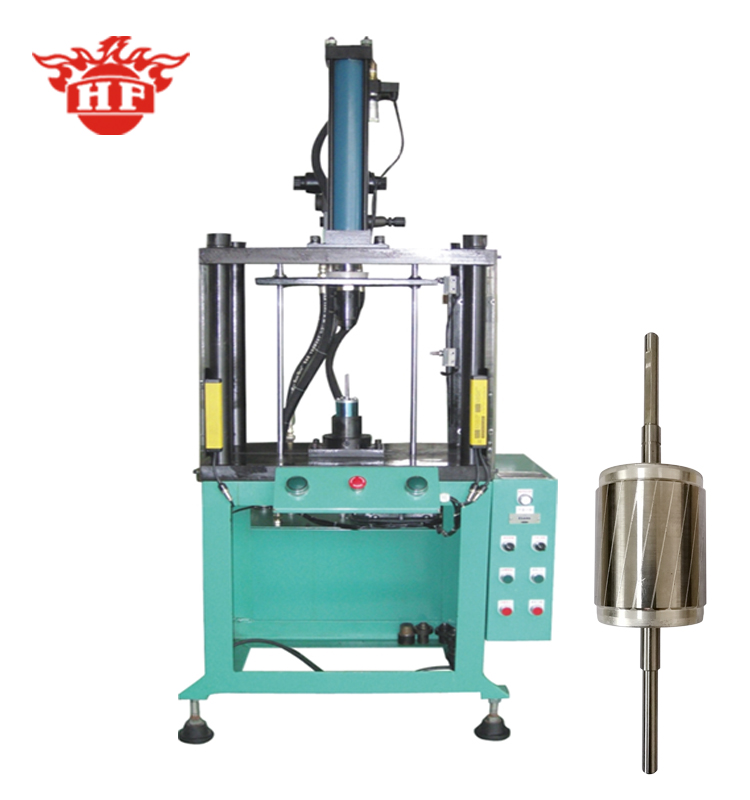
| 6. Final Shaping | HF-W120H Final Forming Machine | Hydraulic 3-Way Pressing Height Tolerances: ±0.3 mm |
Final hydraulic press sizing ensuring end-turn envelope conforms strictly to motor casing blueprints. | End Shield Clearance |
| 7. Rotor Finishing | Rotor Rough & Fine Turning Lathe | Rotor Core OD: 30–150 mm Turning Accuracy: 0.005 mm |
Diamond tool surface turning guaranteeing concentric outer diameter and uniform motor air-gap. | Low Noise & Ripple Reduction |
| 8. Shaft Pressing | HF-W50 Hydraulic Shaft Press | Pressing Force: 5–30 Tons Interference Fit Monitored |
Precision hydraulic alignment pressing SC45# motor shafts into finished rotor cores without runout. | Bearing Seat Runout <0.01 mm |
High-Impact Application Scenarios Across the Greek Industrial Ecosystem
Engineered for the microclimates, operational strains, and maritime standards characteristic of Greece.
1. Marine Propulsion & Sea-Water Auxiliary Pumps
Vessels docked in Piraeus and the ship repair hub of Perama demand marine-grade electric motors engineered to withstand high salinity, aggressive salt mist, and severe structural vibration. Our double-sided lacing machines guarantee rock-solid end-turn binding using marine-certified Nomex and resin-impregnated cords.
The tightly knotted coil heads eliminate strand friction caused by shipboard propeller harmonics, preventing premature insulation varnish cracking in bilge pumps, cargo winches, and engine-room blowers.
2. Deep-Well Submersible Irrigation Pumps
Greece’s major agricultural production depends heavily on multi-stage submersible bore pumps capable of operating under water columns exceeding 150 meters. These motors operate under extreme hydraulic backpressure and high thermal loads within water-filled or oil-filled stators.
Our machines lace stator coils with uniform, high tension, preventing coil displacement when the motor experiences repetitive across-the-line starting torques during agricultural peak cycles in hot Mediterranean summers.
3. HVAC Compressors & Commercial Cold-Chain Blowers
With Greece enforcing stringent EU seasonal energy efficiency ratios (SEER), HVAC and chiller manufacturers in Attica and Northern Greece require tightly packed, high-fill stators.
Our stator forming and automated lacing equipment guarantees exact geometric profile retention, enabling maximum copper density without risk of wires rubbing against internal compressor shells or casing baffles.
4. Renewable Hybrid Drives & Island Desalination Motors
Autonomous island microgrids across the Aegean rely on high-efficiency reverse osmosis desalination plants and wind turbine auxiliary pitch actuators. These motors face high switching frequencies and voltage spikes (dv/dt) from modern variable frequency drives (VFDs).
Precision automated coil lacing maintains strict inter-phase physical separation, eliminating partial discharge phenomena and extending stator lifespan in remote island installations.
Emerging Technological Trends Shaping Greek Motor Manufacturing
1. Accelerated Adoption of Synchronous Reluctance (SynRM) & Permanent Magnet (PMSM) Architectures: As Greek energy costs prompt industrial operators to migrate beyond standard induction machines toward IE4 and IE5 performance, motor factories are developing synchronous reluctance designs. These stators feature concentrated winding patterns with intricate end-turn geometries that are impossible to bind dependably by hand. Programmable multi-axis servo lacing ensures uniform diamond lock-stitching on highly specialized pole pitches without operator fatigue.
2. The Greek Green Shipping Initiative & Harbor Electrification: Piraeus is emerging as a flagship harbor for the European "Green Shipping" decarbonization agenda. Hybrid tugboats, short-sea electric ferries running routes to the Saronic islands, and cold-ironing shore power systems mandate locally serviceable, explosion-proof, and high-reliability motors. Automated coil lacing gives Hellenic electric motor workshops the capability to guarantee class-certified rewinds and OEM builds backed by traceable digital winding parameters.
3. Upgrading from Dispersed Repair Workshops to Automated Cell Manufacturing: Historically, the Greek motor sector was characterized by scattered mechanical rewinding workshops relying on hand mallets and cord. Today, Greek workshops are rapidly consolidating into unified semi-automated cells: pairing automatic coil winders with dual-station lacers and hydraulic forming presses to deliver industrial batches with shorter lead times and measurable QA certification.
Zunqi Intelligent Equipment: 17 Years of Engineering Authority
Direct manufacturer reliability from Dongguan, China—combining custom-engineered tooling with transparent international trade compliance.
Tooling Tailored to Your Part
Every winding former, lacing needle fixture, and forming die is custom-machined via CNC to your exact lamination drawings or physical stator sample.
Pre-Shipment Trial Run Videos
We test-run your physical stator core on our test bench before packaging, sending full multi-angle running videos and parameter checklists for sign-off.
Tier-1 Electrical Architecture
Configurable with global brands you trust: Siemens, Mitsubishi, Schneider, Delta, or Omron PLCs and servo drives for painless local maintenance in Greece.
Piraeus & Thessaloniki Direct Sea Freight
Expert export packing in fumigation-free solid plywood crates with VCI anti-corrosion barrier wrapping, dispatched directly via primary shipping routes.
Frequently Asked Questions by Greek Industrial Buyers
Practical answers on customs, voltage settings, tooling customization, and warranty operations in Greece.
Q1: How do you configure machine power for Greek industrial facilities?
All machinery exported to Greece is configured precisely to Greek and European distribution standards: 400V 3-Phase ±10%, 50Hz, or 230V Single-Phase 50Hz. Electrical cabinets feature CE-compliant Schneider or Delta switchgear, neutral-isolated grounding bars, and surge arresters calibrated for industrial parks.
Q2: Can the coil lacing machine handle stators with varied stack heights?
Yes. Our lacing machines feature programmable servo vertical indexing. If you produce or rewind motors across diverse core stack heights (e.g., from 40 mm to 160 mm on the same frame OD), the operator simply inputs the target stack height on the HMI touch screen without needing mechanical rebuilds.
Q3: Can we order custom tooling for obsolete or non-standard Greek stators?
Absolutely. You can provide technical PDF CAD blueprints (DWG/DXF) or air-freight a physical sample core to our Dongguan factory. Our design engineers model the expansion mandrels, slot clamps, and needle stroke geometry specifically around your sample, verifying zero wire bite before dispatch.
Q4: What is the standard ocean shipping transit time to Piraeus or Thessaloniki?
Direct ocean container freight from Shenzhen or Guangzhou ports to the Port of Piraeus typically takes 24 to 32 days, while shipping to Thessaloniki averages 28 to 35 days. We provide comprehensive export documentation including Bill of Lading, Commercial Invoice, Packing List, and Certificate of Origin.
Q5: What after-sales and commissioning support is provided in Greece?
Every machine is backed by our standard 1-Year Comprehensive Warranty on core gear, PLC, and drive components. We furnish complete English user manuals, circuit wiring schematics, and interactive HD video tutorials. Our engineering desk provides remote video commissioning support via WhatsApp, Zoom, or WeChat within a guaranteed 9-hour window.
Q6: Which lacing cords and cord materials are compatible?
Our needle guide and tension assemblies support diverse cord types: flat or round polyester cord, braided Nomex tape, polyamide thread, and heat-shrinkable polyester lacing twine with tensile strengths from 15 kg to 60 kg, preventing snapping during high-speed cycle runs.
Q7: What is the Minimum Order Quantity (MOQ) for an automated lacing machine?
Our MOQ is exactly 1 Set. Whether you run a high-volume appliance motor production line in Sindos or a dedicated electrical repair and rewinding plant near Piraeus harbor, you can acquire an individual standalone machine or complete production cells tailored to your budget.
Q8: How is enamel wire protected from scratching during high-tension lacing?
Our lacing needles and thread feed eyes are crafted from mirror-polished tungsten carbide or ceramic-coated tool steel. The stitch movement trajectory is calculated via CNC algorithms to enter the slot gap without touching the copper wire bundles, preserving full dielectric insulation properties.
Modernize Your Stator Production Line for Greece Today
Send your stator core blueprints (ID, OD, stack height, and slot profile) or motor photos. Our application engineering team will provide a comprehensive machine proposal, tooling evaluation, and CIF Piraeus quotation within 9 hours.
