Standard & Custom Stator Automation Solutions
Direct factory supply of precision coil forming, winding, wedge inserting, and shaft assembling systems engineered to exacting European industrial tolerances.
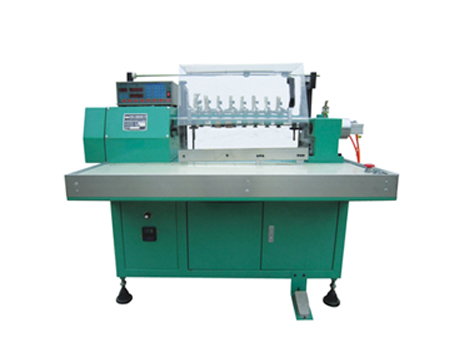
Electrical Motor Stator Coil Winding Machine for Cooler Motor
- Automatic Multi-Strand Wire Array
- High Fill-Factor Coil Precision
- Industrial PLC Controller Interface

Electric Motor Spares SC45# Low Carbon Steel Fan Motor Shafts
- SC45# Normalized Carbon Steel
- Precision Ground Tolerance (h6/h7)
- Anti-Rust Surface Pre-Treatment

Two Stations Outer Stator & Transformer Coil Winding Machine
- Continuous Dual-Station Output
- Tension-Regulated Wire Feeding
- Multi-Layer Synchronous Winding

Hot Sale Automatic Armature Winding Machine for Fan Motor
- Flyer High-Speed Winding Head
- Auto Commutator Hooking & Indexing
- Zero-Scuff Enamel Wire Protection

HF Single Side Stator Coil Lacing Machine (1000W 380V/220V)
- Rigid Mechanical Cam Drive
- Selectable Pitch & Skip Lacing
- High Binding Tension Stability

Slot Paper Inserting & Cutting Machine for Pump & Fan Motors
- Simultaneous Creasing, Edge-Hemming
- Slot-to-Slot Indexing Precision
- Supports Nomex, DMD, Mylar

HF-W120H Motor Stator Coil Final Forming Shaping Machine
- Multi-Directional Hydraulic Compaction
- Internal Expanding & External Clamping
- Strict End-Turn Overhang Control

Hydraulic Motor Stator Shaft Inserting Press Machine
- Closed-Loop Tonnage Control
- Micrometric Insertion Depth Accuracy
- Prevents Core Lamination Flaring
Precision Coil Forming in the Bordeaux Industrial Ecosystem
Analyzing electromagnetic manufacturing demands across Southwestern France, from Aerospace Valley actuators to high-viscosity viticultural pumping drives.
Aerospace Valley Flight Actuators
Across the Bordeaux-Mérignac aerospace cluster, electromechanical flight surface actuators and secondary flight drives require stators with uncompromising geometric symmetry. Our intermediate and final coil forming machines compact copper end-turns to millimeter-exact envelope boundaries, eliminating clearance interference within ultra-compact titanium nacelles and pressurized avionics enclosures.
Viticultural Pumping & Bottling Lines
The Gironde wine sector relies heavily on continuous-duty, stainless-steel positive displacement and peristaltic pumps. Stators operating in humid, washdown cellar conditions demand immaculate slot-paper integrity. Our machines use hydraulic segmented expanders that push coil bundles into optimal position without chafing enamel or micro-fracturing phase barrier insulation, preventing premature winding breakdown.
Naval & Port Automation Drives
From the Port of Bordeaux (Bassens maritime hub) to regional rail infrastructure along the Garonne corridor, heavy auxiliary drives must withstand sustained shock loads. Multi-station forming compresses coil heads mechanically to optimize subsequent double-side lacing, creating a rigid stator end-basket capable of withstanding dynamic vibrations and severe thermal cycling without inductive leakage.
Technological Evolution: Meeting EU Ecodesign & IE4/IE5 Mandates
How modern coil forming kinetics directly influence stator slot fill factor, magnetic flux density, and thermal heat dissipation in high-efficiency industrial motors.
The Kinematics of Stator Coil Forming: Overcoming Enamel Stress & Insulation Creep
In classical electric motor manufacturing, the end-winding forming process is often treated as a crude sizing operation. However, under the strict energy performance guidelines enforced across France and the wider European Union under Commission Regulation (EU) 2019/1781 (laying down ecodesign requirements for electric motors), the geometric configuration of stator end-turns has direct thermal and electromagnetic ramifications.
When an inserted stator coil overhangs the lamination stack excessively, mean-length turn (MLT) resistance increases exponentially. This parasitic resistance generates additional Joule loss (I²R heating), lowering motor efficiency from the mandated IE4 (Super Premium) or IE5 (Ultra Premium) thresholds down to obsolete IE2/IE3 performance tiers. Conversely, over-aggressive cold deformation during forming can induce micro-cracking in polyester-imide/polyamide-imide magnet wire coatings, resulting in inter-turn dielectric punch-through under high-frequency pulse-width modulated (PWM) inverter inverter drive stresses.
Our HF-W120H final forming machine architecture addresses these metallurgical phenomena through a precisely sequenced, three-phase hydraulic kinematics sequence:
- Phase 1: Radial Internal Expansion. Hardened segment fingers enter the stator bore and expand outward, maintaining precise air-gap clearance tolerances (±0.05 mm) while supporting the internal slot-exit radius against mechanical pinching.
- Phase 2: Axial End-Turn Compaction. Controlled top and bottom shaping dies descend axially, compressing coil overhangs to target stack limits. Displacement velocity is damped smoothly as pressure builds, giving copper strands time to realign plastically along natural slip planes.
- Phase 3: Circumferential External Clamping. Segmented outer clamps close inward, calibrating the outer perimeter of the end-turn basket to ensure generous radial clearance against the motor housing frame and mounting stud channels.
| Kinematic Stage | Mechanism Type | Pressure / Force Vector | Tooling Metallurgy | Dimensional Tolerance | Bordeaux Production Benefit |
|---|---|---|---|---|---|
| Intermediate Forming (Pre-Lacing) | Pneumatic / Low-Hydraulic | Internal Radial Expansion (1.5–3.0 MPa) | Cr12MoV (HRC 58-62) | ±0.12 mm | Opens clear central path for automated lacing needles; avoids cord snagging. |
| Final Sizing (Post-Lacing) | Hydraulic Proportional System | Tri-Axial Compound Force (Up to 150 kN) | Hard Chrome Plated DC53 (HRC 60-64) | ±0.05 mm | Tightest coil head height envelope; ensures direct fit inside low-profile housings. |
| Shaft Inserting Press | Rigid Hydraulic Cylinder | Axial Linear Thrust (50–120 kN) | 40Cr Quenched & Tempered Core | ±0.02 mm Depth | Zero core skewing; preserves critical laminar magnetic permeability. |
| Slot Insulation Folding | Mechanical Cam / Stepper | Bending & Shear Cutting | SKD11 Tungsten Carbide Inserts | ±0.03 mm Edge | Zero fiber fraying on DMD/Nomex; zero dielectric breakdown at slot corners. |
Turnkey Stator Production Line Configuration
Engineered for seamless cycle-time matching, standardized tool changes, and high-repeatability batch manufacturing.
Slot Cell Insertion
Automatic creasing, cutting, and slot insertion of electrical grade insulation paper into all stator teeth slots simultaneously.
Stator Coil Winding
Continuous flyer or needle winding of high-purity copper/aluminum magnet wire into balanced multi-pole winding groups.
Coil & Wedge Inserting
Simultaneous insertion of wound coil clusters and protective slot closure wedges into stator slots in a single mechanical stroke.
Intermediate Forming
Preliminary hydraulic expansion shaping coil heads outward to clear the central bore for subsequent automatic lacing.
End-Turn Lacing
High-tension single or double-side diamond/slot lacing to mechanically bundle and brace end windings against vibration.
Final Precision Forming
Three-directional hydraulic sizing die sets calibrate the absolute height, ID, and OD of the stator end basket to drawing specs.
Rotor Fine Turning
Diamond-tool outer surface cutting of stacked squirrel-cage rotors to maintain uniform, micro-tolerance air gap geometry.
Hydraulic Shaft Pressing
Precision alignment press-fitting of SC45# steel rotor shafts into laminated rotor packages with monitored load curves.
Bordeaux Buyer Frequently Asked Questions
Key engineering, electrical standard, and logistics criteria for equipment imported into France and Nouvelle-Aquitaine.
Are your coil forming and stator machines fully compliant with European CE and French electrical safety standards?
Yes. All machines exported to the French market comply with the Machinery Directive 2006/42/EC, Low Voltage Directive 2014/35/EU, and Electromagnetic Compatibility (EMC) Directive 2014/30/EU. Electrical cabinets are designed strictly according to EN 60204-1 safety of machinery guidelines, featuring standard dual-channel safety relay loops, Pilz/Schneider emergency stop circuits, interlocked safety guards, and shielded cabling for high-noise industrial environments.
Can machine electrical control cabinets be customized with French or German standard components?
Absolutely. While our standard configuration utilizes premium industrial PLCs and servo drives (such as Inovance and Delta), we routinely assemble electrical enclosures specified with Siemens S7-1200/1500, Schneider Electric Modicon, or Omron control architectures. Pneumatics can be standardized entirely on SMC or Festo valves and cylinders to ensure direct local replacement component availability in Bordeaux distributors.
What factory power grid parameters are required, and how do you accommodate 400V 50Hz 3-phase systems?
French manufacturing installations generally operate on 400V 3-phase, 50 Hz, with TN-S or TT grounding. Our heavy hydraulic and dual-station machines are wired natively for 380–415V 50Hz 3-phase systems, with internal multi-tap isolation transformers when auxiliary components require clean 230V or regulated 24V DC control power. Electrical drawings and wiring harnesses are delivered in bilingual English/French format with clear DIN terminal markings.
How do you validate custom stator tooling before the machine departs your manufacturing facility?
We operate a rigorous Factory Acceptance Testing (FAT) protocol based on physical customer samples. Prior to metal cutting, our tooling engineering department reviews your stator lamination drawings (including stack height, slot dimensions, core OD/ID, and magnet wire diameter). Once tooling is hardened and wire-EDM cut, we require clients to courier 5 to 10 physical stator packs to our Dongguan facility. We perform actual winding, inserting, forming, and surge-testing cycles, providing complete high-definition video documentation and CMM dimension verification reports before client sign-off.
What are the sea freight and customs clearance pathways into Bordeaux and Southwestern France?
For industrial machinery delivered into Nouvelle-Aquitaine, freight typically ships via ocean container from Shenzhen or Guangzhou ports directly to Le Havre or Fos-sur-Mer, connecting via bonded rail/road feeder directly to Bordeaux (Bassens Logistics Terminal). Alternatively, shipments can be consigned under FOB, CIF, or DDP (Delivered Duty Paid) Incoterms, where our freight forwarding partners handle customs brokerage, import VAT documentation, and heavy-cargo tail-lift unloading at your facility.
What post-delivery support, commissioning, and warranty terms are provided to French motor manufacturers?
Every piece of equipment is backed by a 1-year comprehensive mechanical and electrical warranty. We supply full English operation manuals, electrical schematics, and high-definition video tutorials detailing tool changeovers, cam timing adjustments, and hydraulic pressure calibration. In addition, our English-speaking senior automation engineers provide remote commissioning support via video link within an average response window of ≤9 hours. Critical wearing parts (such as forming fingers, cutting blades, and lacing needles) are packed in redundant quantities inside the shipping crate.
Zunqi Intelligent Equipment: 17+ Years of Motor Automation Excellence
Headquartered in Qishi Town, Dongguan, Zunqi Intelligent Equipment Co., Ltd. operates at the global epicenter of electro-mechanical equipment engineering. Over nearly two decades of international trade, our technical team has engineered custom stator winding, wedge inserting, precision forming, and rotor balancing equipment for electric motor manufacturers across more than 40 countries.
- Dedicated Tooling Engineering: Custom forming dies and expansion fingers CNC-machined from DC53 and Cr12MoV vacuum-quenched alloy steels for zero galling and sustained 100,000+ cycle service life.
- Systemic Stator Line Compatibility: Every standalone forming, winding, or lacing machine is designed with coordinated conveyor pass heights and unified PLC protocols for future robotic cell integration.
- Verified Onsite Credibility: Comprehensive audited operations, verified credit status, transparent track record, and direct factory-floor access for overseas technical inspection teams.
Direct Factory Procurement Checklist
To accelerate technical review and receiving a formal proposal for your Bordeaux plant, prepare the following parameters:
- Stator lamination drawing with outer/inner diameter and stack height.
- Number of slots and slot cross-sectional profile drawing.
- Coil head height constraints and target wire gauge (SWG/AWG/mm).
- Target cycle time per piece (seconds) or batch shift throughput.
- Preferred PLC & electrical component brand specifications.
Modernize Your Electric Motor Line in Bordeaux
Consult with our senior technical engineering desk today. Get customized forming tooling drawings, mechanical cycle-time simulations, and factory-direct pricing tailored to your production requirements.
Get Catalog