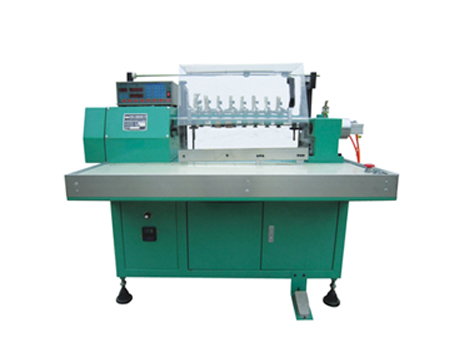
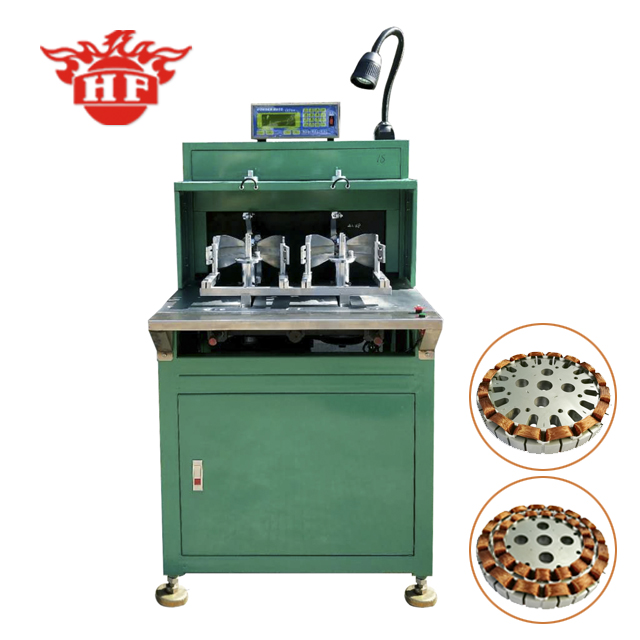
Engineered for high slot-fill ratios, precise geometric expansion, and minimal enamel stress across industrial motor production lines.
Within rotating electrical machinery, the coil overhang (end-turn region) represents the most vulnerability-prone mechanical zone of a stator winding. During initial winding and inserting processes, copper magnet wires endure high dynamic tension and friction against slot paper lips. Without precision multi-stage coil forming (pre-forming, intermediate shaping, and final volumetric sizing), protruding conductors risk contacting the rotor during assembly, suffering dielectric breakdown against end-laminations, or exceeding allowable exterior dimensional envelopes prescribed by frame housings (such as IEC frames 71 to 132).
Our coil forming machines utilize dedicated solid-alloy expansion mandrels and precision outer radial blocks actuated via proportional hydraulic and servo drives. By ensuring balanced perimeter pressure distribution, the machines shape the inner diameter to guarantee unambiguous rotor clearance, compress end-turn heights for optimum thermal transfer toward end-shield ventilation paths, and protect the polyamide-imide or polyester enamel layer from micro-cracking and inter-turn phase faults.
The manufacturing ecosystem of Southern Portugal is transitioning toward advanced industrial retrofitting, renewable systems, and clean mobility technologies.
In the industrial clusters surrounding Sintra, Loures, and Vila Franca de Xira, industrial chiller assembly and agricultural pump fabricators depend on high-efficiency single and 3-phase induction stators. Automatic wedge insertion and intermediate forming ensure maximum copper slot fill without inducing pinholes in damp Mediterranean environments.
With clean energy initiatives accelerating across the Setúbal and Palmela corridor,Tier-2 automotive suppliers and specialized e-mobility workshops require flexible forming stations capable of handling heavy-gauge round wire and segment winding profiles for compact auxiliary steering and cooling blower motors.
Across the logistics hubs of Carregado and Azambuja, heavy industrial apparatus operators demand reliable stator rewind and coil reshaping equipment to restore marine auxiliary engines, gantry crane propulsion drives, and industrial air handling systems to original OEM specifications.
Mechanical parameters engineered to integrate directly into European continuous manufacturing workflows.
| Platform Model | Primary Application | Stator OD Range | Stack Height Range | Actuation Mode | Cycle Time / Unit |
|---|---|---|---|---|---|
| HF-W120H Forming Station | Final Volumetric End-Turn Sizing | Ø 40mm – Ø 160mm | 10mm – 160mm | Proportional Hydraulic / Servo | 4.5s – 7.0s |
| HF-BS20 Servo Lacing | Dual-End Continuous Cord Binding | Ø 50mm – Ø 190mm | 15mm – 180mm | Dual Axis Delta / Panasonic Servo | ≤ 0.8s / slot pitch |
| HF-D50 Paper Inserter | High-Dielectric Slot Liner Placement | Ø 30mm – Ø 140mm | 8mm – 120mm | Precision Stepper + Cam Indexer | 0.35s – 0.5s / slot |
| HF-C60 Turning Cell | Air-Gap Skim & Rotor Concentricity | Up to Ø 100mm | Up to 200mm | High-Rigidity Dynamic Lathe Feed | 10.0s – 18.0s (full pass) |
How Lisbon's industrial modernizers leverage automated winding and coil shaping infrastructure to navigate market challenges.
Under the European Union Ecodesign Directive (EU 2019/1781), standard induction motors operated across Portugal must conform to minimum IE3 and IE4 efficiency metrics. Achieving these benchmarks requires packed slot geometries and thicker wire gauges, necessitating hydraulic-assisted end-turn shaping to maintain critical magnetic envelopes.
Rising labor rates in the Lisbon-Cascais-Sintra tech and manufacturing triangle demand accelerated transition away from manual coil forming and malleting. Transitioning to repeatable multi-axis tooling eliminates operator variability, curtails rework costs, and delivers predictable parts-per-hour output rates.
Portuguese engineering hubs are increasingly adopting predictive maintenance protocols. Our export machines feature standardized Industrial Ethernet communication protocols (Modbus-TCP, Profinet-ready architectures) allowing integration with plant-wide SCADA infrastructures and Portuguese ERP deployments.
Combining world-class component sourcing, proven tooling fabrication, and strict international export protocols.
Our premises and operations in Qishi Town, Dongguan, are independently verified on Alibaba.com. With over 17 years handling European export logistics, we guarantee customs documentation, correct HS code assignments, and secure ocean freight through the Port of Lisbon (Porto de Lisboa) or Leixões.
Eliminate maintenance headaches. We engineer our automation platforms utilizing control elements configured to your exact maintenance standards: Siemens, Schneider Electric, Omron, Mitsubishi, Delta, or Inovance, paired with genuine SMC or Airtac pneumatic logic valves.
No machine leaves our factory untested. Portuguese procurement teams simply ship physical stator cores and copper wire samples to our test bench. We run complete trial runs, measure dimensional repeatability, and furnish full video evidence before export sign-off.
Practical guidance addressing logistical, electrical, and technical integration queries.
Contact our engineering specialists today for complete cycle time assessments, tooling layout schematics, and factory-direct pricing for Lisbon and international delivery.
Get Catalog