8 Heads · 3000 RPM
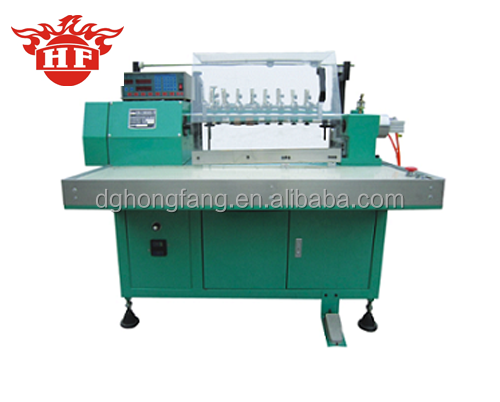
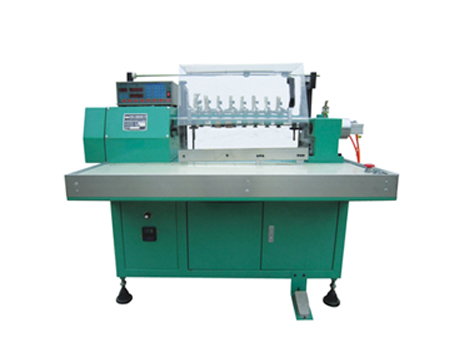
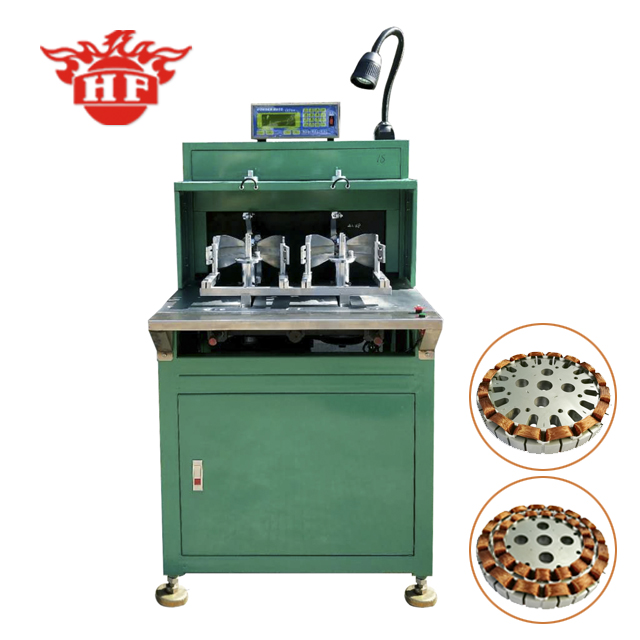
HF New CNC Auto Stator Coil Winding Machine for Table Fan Motor Semi Coil Making
- 8-Spindle High-Speed Array
- Rated up to 3000 RPM Spindle Velocity
- Microprocessor CNC Wire Indexer
Direct from Zunqi Intelligent Equipment: high-reliability machinery designed to integrate seamlessly into North American 480V/208V electrical architectures and custom production lines across the Portland metropolitan region.
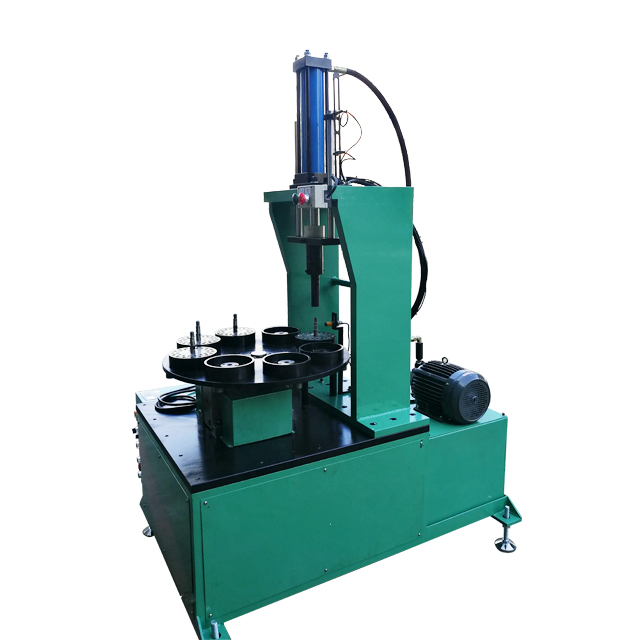
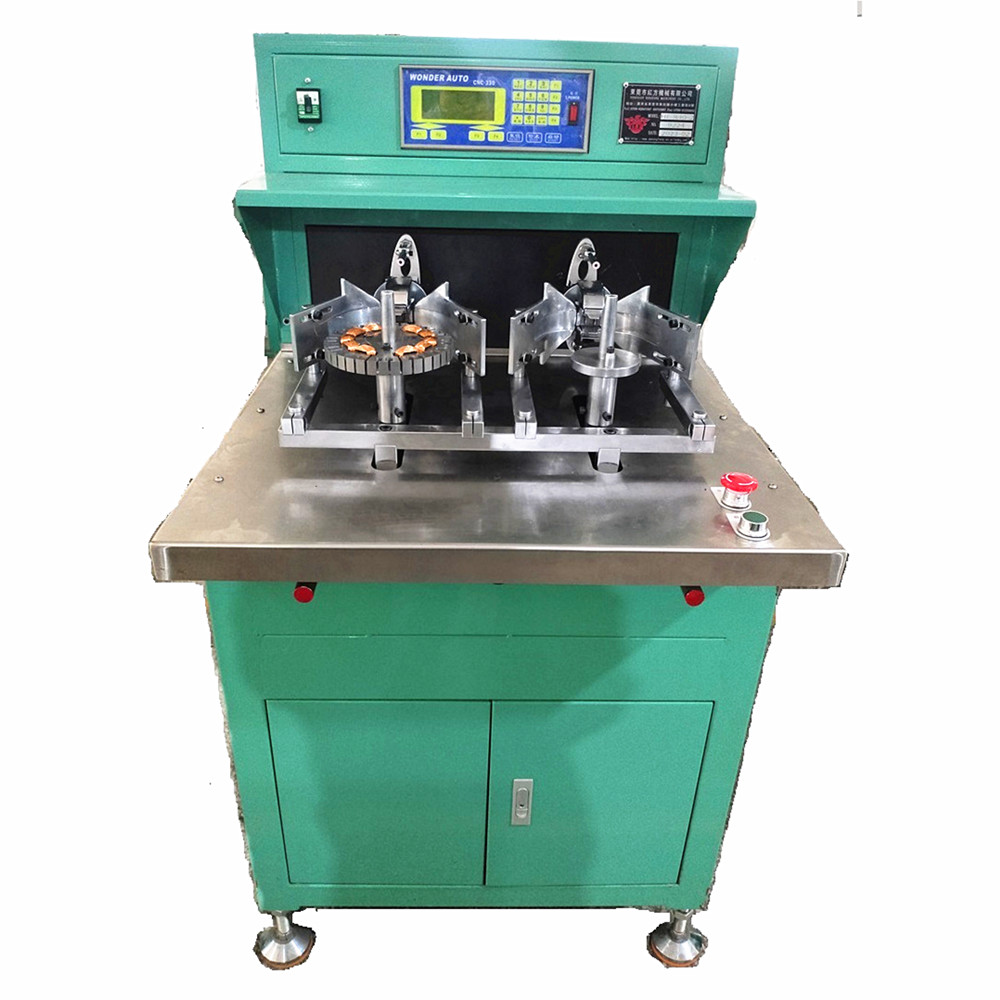
Achieving tight magnetic air gaps, eliminating insulation dielectric degradation, and managing copper slot-fill economics in sub-fractional to medium-frame electric motors.
In high-efficiency electric motor manufacturing, the insertion of magnet wire into slotted lamination stacks represents only half of the electromechanical equation. The geometric boundary condition of the stator end turns—the copper bundles protruding axially from both sides of the stator core—determines not only physical clearance within the motor housing, but also dielectric endurance, partial discharge thresholds, thermal dissipation profiles, and subsequent rotor-insertion clearance. As motor architectures shift toward higher power densities across industrial hubs like the Portland, Oregon metropolitan corridor, precision coil forming equipment has transitioned from an auxiliary secondary operation into an exacting, mission-critical phase of electric machine assembly.
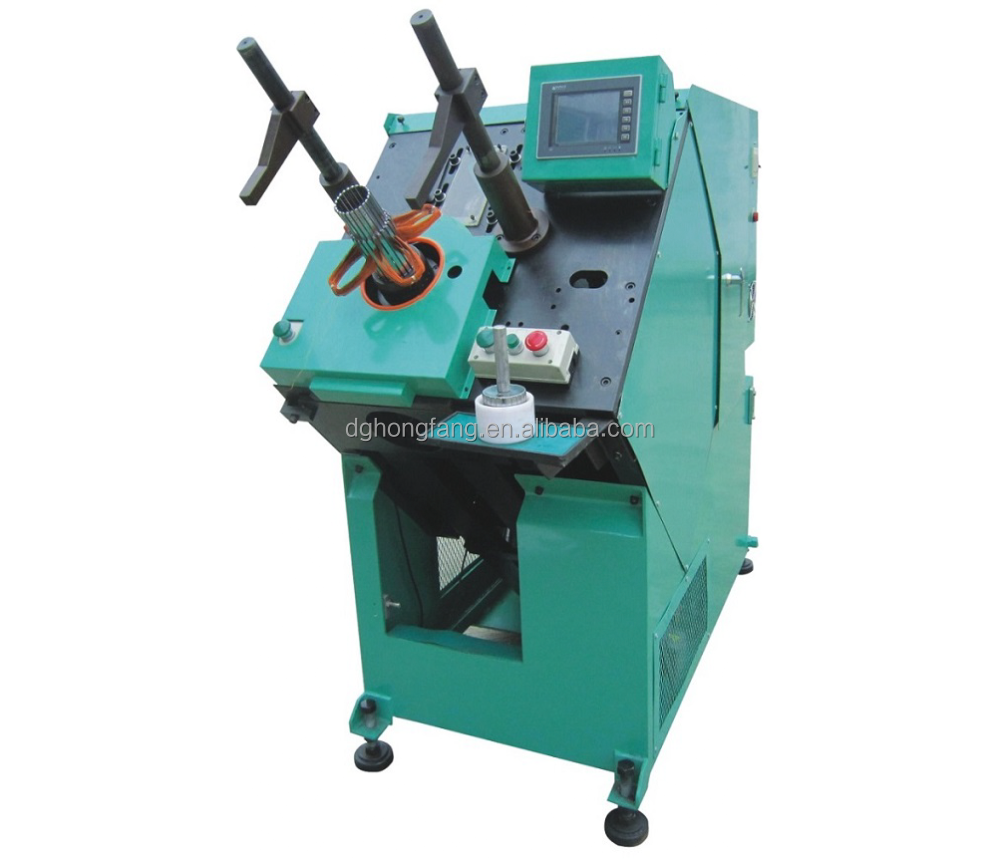
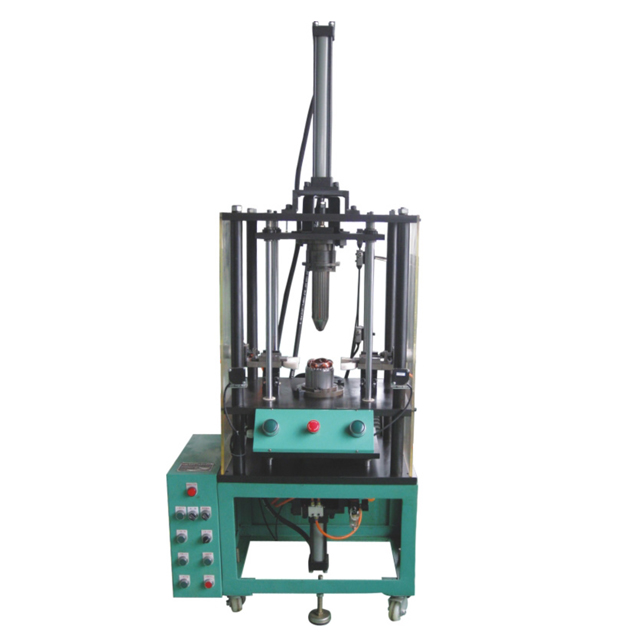
Coil forming machines operate primarily in two sequential phases: intermediate forming (pre-forming) and final forming (post-lacing calibration). During the intermediate stage, the machine's expanding internal mandrel enters the stator bore while external segment dies radially compress the end turns outward and axial pushers control the overall overhang height. This mechanical excursion achieves two objectives: it clears the central stator bore to allow clear passage for lacing needle tooling and establishes the necessary radial clearance for secondary slot wedge insulation. In the final forming stage, executed after single-side or double-side coil lacing cord has been applied, high-tonnage multi-axis forming tooling executes a compound stroke that sizes the coil head to its definitive engineering envelope.
Enamelled magnet wire (Grade 180°C or 200°C polyester-imide/polyamide-imide overcoat) suffers micro-cracking under excessive local mechanical elongation. Zunqi forming dies feature CNC-machined, mirror-polished radii and hydraulic-cushioned descent rates to prevent insulation wall rupture.
In fractional horsepower (FHP) and medium industrial stators, internal clearance tolerances between the coil knee and the rotor outside diameter are frequently less than 0.35 mm. Precision multi-jaw expanding arbors ensure that no individual wire strand bulges into the active magnetic air path.
Excessive axial coil overhang adds inactive copper resistance without contributing to shaft torque, degrading overall operating efficiency (NEMA Premium / IE3 / IE4). Dedicated end-turn axial forming compacts the turn package, slashing $I^2R$ copper losses and reducing motor housing depth.
Selecting the appropriate kinematic mechanism for coil head reshaping depends upon slot-fill density, lamination stack rigidity, and targeted cycle time:
| Architecture Type | Primary Actuation | Forming Precision (Axial/Radial) | Ideal Slot Fill Factor (η) | Typical Cycle Time | Primary Industrial Use-Case |
|---|---|---|---|---|---|
| Hydraulic 3-Axis Forming | Hydraulic Power Pack with Proportional Valves | ±0.10 mm / ±0.08 mm | High Fill (>75% Copper) | 6.0 – 9.0 sec | Industrial HVAC pumps, heavy compressors, commercial fan motors |
| Pneumatic Toggle Forming | Multi-stage Air Cylinders with Mechanical Linkage | ±0.25 mm / ±0.20 mm | Moderate Fill (55% – 68%) | 3.5 – 5.0 sec | High-throughput residential appliance motors, table fans, coolers |
| Servo-Electric CNC Forming | Direct AC Servo with Ballscrew & Torque Feedback | ±0.03 mm / ±0.02 mm | Ultra-Dense (>80% Hairpin/Needle) | 4.5 – 6.5 sec | Automotive EV powertrains, aerospace robotic actuators, medical drives |
How OEMs and precision machine builders in Portland, Hillsboro, Beaverton, and Vancouver, WA deploy Zunqi motor manufacturing and coil forming technology.
The manufacturing ecosystem of the Portland–Vancouver–Hillsboro Metropolitan Area is defined by high-technology innovation, clean energy manufacturing, commercial aerospace actuation, and demanding maritime fluid systems along the Columbia River basin. Unlike high-volume consumer appliance centers in East Asia, Pacific Northwest motor builders focus heavily on specialized, high-reliability, custom-engineered electromagnetic devices. Below are the key regional use-cases where coil forming and stator automation machinery deliver significant competitive advantage:
Advanced fabrication plants (fabs) in Washington County demand ultra-low-vibration, electronically commutated (EC) and permanent magnet synchronous fan motors (PMSM) for continuous air filtration (HEPA/ULPA recirculators). Stator coil forming guarantees perfectly uniform phase balance and symmetrical end turns, eliminating electromagnetic cogging and structural vibration harmonics that could impair photolithography equipment.
Oregon's rigorous building decarbonization mandates require variable-speed, ultra-high-efficiency water circulation pumps. The HONGFANG Motor Stator Coil Forming & Shaping Machine compresses stator end turns within compact cast-iron or stainless steel canned-rotor geometries, ensuring watertight encapsulated housings do not contact copper windings during high-temperature cycling.
Suppliers within the I-5 aerospace industrial cluster producing flight control servomotors, fuel pump drives, and wing-surface actuators require extreme resistance to vibration fatigue. Combined automated coil winding and precision mechanical lacing lock down every wire bundle, ensuring stators endure rigorous MIL-STD-810 and RTCA DO-160 vibration profiles.
Navigating energy standards, reshoring dynamics, and automation modernization across Oregon and Washington state industrial sectors.
Industrial procurement specialists and manufacturing engineering directors in the Portland region operate in an environment influenced by rapid technological change, assertive regional decarbonization targets, and supply chain reshoring initiatives. The transition toward localized, resilient production lines has elevated the standard of equipment acquisition:
With Oregon driving clean energy standards and utility incentive programs through the Energy Trust of Oregon, commercial HVAC, pumping, and refrigeration OEMs are forced to elevate baseline motor efficiencies to NEMA Premium and Super-Premium (IE4/IE5) standards. Achieving this without redesigning overall frame dimensions requires increasing active copper volume within existing stator slots. High-precision coil wedge inserting and forming machines allow manufacturers to achieve slot fill factors exceeding 75% without generating short-circuiting phase faults.
Escalating skilled manufacturing wages throughout the Pacific Northwest have made manual stator coil winding, hand wedge tapping, and mallet-based end-turn forming economically unviable. Transitioning to automatic multi-station coil inserting and lacing lines enables a single technician to oversee the production throughput previously requiring eight manual bench assemblers, while reducing variability in coil head geometry.
The Portland metro area has emerged as an incubator for electric micro-mobility, light commercial electric vehicle (EV) platforms, and agricultural electric equipment. These agile engineering entities require automated tooling that allows rapid changeovers between varied stack heights, stator outside diameters (OD), and slot configurations. Modular forming toolsets reduce tooling changeover windows from an entire shift down to under 45 minutes.
Technical, electrical, logistical, and warranty considerations addressed directly by Zunqi's senior motor engineering desk.
While our standard machines are configured for single-phase 220V or three-phase 380V 50Hz, all export machines bound for the United States—including facilities across the Portland, OR metropolitan area—are built with customized electrical enclosures. We integrate UL-recognized electrical panels, internal step-down isolation transformers, and dual-rated 50/60Hz servo power stages compatible with 480V/277V or 208V/120V 3-phase plant supplies. Component architecture (PLCs, contactors, overloads) can be configured to familiar North American industrial standards such as Allen-Bradley, Siemens, or Omron upon request.
Shipments departing from our Dongguan, China assembly facility typically route through the Port of Shenzhen or Hong Kong, transiting via ocean freight directly to the Port of Portland (Terminal 6) or through the Ports of Seattle/Tacoma before rail transfer. Ocean transit takes approximately 18 to 24 days, with customs clearance taking 2 to 4 business days. For urgent engineering prototypes or replacement tooling dies, expedited air freight directly into Portland International Airport (PDX) delivers in 5 to 7 business days. Every machine is vacuum-sealed with anti-rust VCI film and crated in heavy ISPM-15 certified fumigation-free timber cases.
Yes, bespoke tooling design is the foundation of our engineering workflow. We request your 2D/3D CAD models (STEP, DXF, DWG) showing stator inner diameter (ID), outer diameter (OD), total stack height, slot dimensions, wire gauge (AWG or mm), turn count per phase, and target end-turn envelope. Our tool engineers design matching expanding arbors, outer forming collets, and bottom positioning plates using high-grade Cr12MoV tool steel vacuum-hardened to HRC 58-62. We recommend sending 5 to 10 physical blank stator stacks and a sample spool of magnet wire for full pre-shipment trial forming and high-voltage dielectric verification.
Intermediate forming occurs directly after the coil inserting process. Because magnet wire bundles spread outwards irregularly when pushed into the stator slots, an intermediate former gently gathers the coil heads and clears the inner bore diameter. This ensures the stator lacing needle can sweep through the slot exits without impaling or stripping the magnet wire insulation. Final forming occurs after lacing cord has been tied around the end turns; it applies calibrated mechanical pressure to compact the copper bundle to its final specified dimensions so the stator fits into its motor casing without rubbing.
Every machine is backed by our standard 1-year factory warranty covering all non-consumable mechanical and electrical parts. All machines feature English HMI interfaces and PLC network ports for remote troubleshooting and firmware updates. When diagnosing process parameters, our engineers review high-definition video of the forming cycle and provide parameter adjustment maps typically within 9 hours (bridging the US Pacific time zone difference). A complete wear-parts kit (forming blades, push rods, springs, proximity sensors) is packed inside the machine crate upon dispatch.
While our standard catalog models—such as the HONGFANG Motor Stator Coil Forming & Shaping Machine—are optimized for round enamelled copper or aluminum wire in distributed winding stators, Zunqi designs bespoke hydraulic and servo-electric forming machines for rectangular cross-section wire and concentrated pole tooth topologies (common in direct-drive wind turbines and drone propulsion). Tooling for rectangular conductors features specialized roller-guided dies that preserve edge insulation integrity and prevent high-stress copper work-hardening.
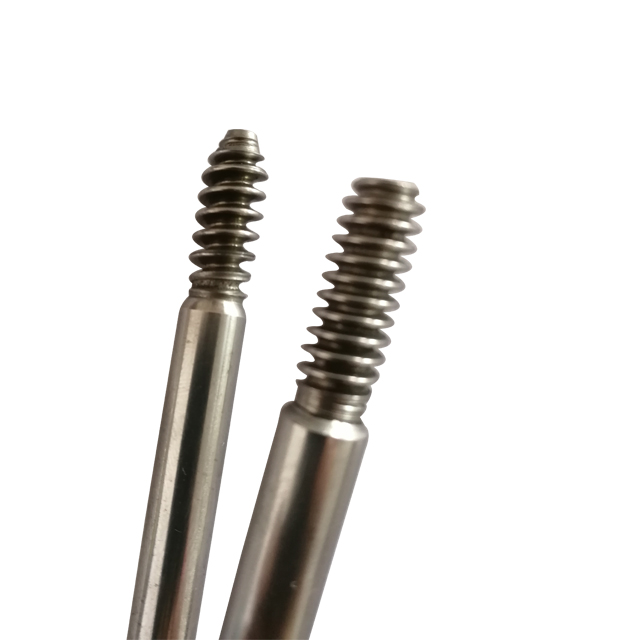
Our minimum order quantity is exactly 1 set for all standalone machines, whether you require an 8-spindle CNC winder, a hydraulic shaft inserting press, or a single stator forming press. For complete turnkey production cells (slot paper inserter → coil winder → coil & wedge inserter → intermediate former → lacing machine → final former), we coordinate kinematic speeds across all stages. Standard commercial terms are 30% advance deposit via wire transfer (T/T), with the 70% balance payable upon review of final factory testing videos on your proprietary stator parts prior to export crating.
Headquartered in Qishi Town, Dongguan—the epicenter of global electro-mechanical equipment fabrication—Zunqi Intelligent Equipment Co., Ltd. combines technical depth with transparent international trade governance.
Over seventeen years of verified international trade records on Alibaba.com, serving precision motor builders across North America, Europe, and Southeast Asia.
We design and manufacture the entire stator assembly line. Tooling tolerances, transfer arms, and cycle-time handoffs are calibrated under one roof for seamless integration.
Choose from global component leaders (Siemens, Mitsubishi, Schneider, Omron, Delta, SMC) so your maintenance technicians can service panels using local spares.
Whether you are engineering high-efficiency HVAC fans in Portland, precision water circulation pumps, or custom aerospace actuators, our technical sales engineers will review your stator stack geometry and deliver a comprehensive machine and tooling proposal.
