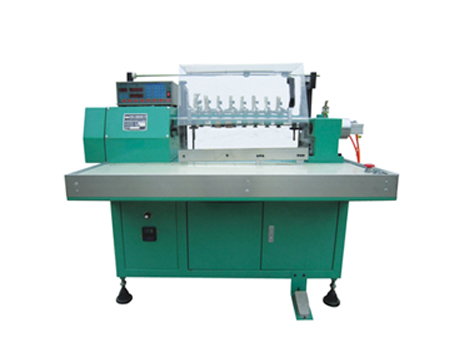
HONGFANG Motor Stator Coil Forming & Shaping Machine for Manufacturing Plant New 1 Year Warranty 1 kW
- Hydraulic/pneumatic dual-stage shaping
- Ensures end-turn clearance before lacing
- Cycle time: 10–14 seconds per stator
Explore our factory-direct electric motor machinery built in Dongguan, China. Configured specifically for 50Hz single/three-phase operating environments across Uruguayan pump, agro-industrial refrigeration, and electric drive manufacturing sectors.
In high-efficiency electric motors (IE2 to IE4), the quality of coil end-turn binding dictates mechanical resonance resistance, heat dissipation dynamics, and corona discharge prevention under variable frequency drive (VFD) switching harmonics.
Manual lacing of stator coil overhangs has historically been the primary failure point in South American electric motor production and remanufacturing plants. Irregular tension leads to loose end-turns that vibrate at double line frequency (100 Hz on the 50 Hz Uruguayan grid), ultimately inducing inter-turn insulation fatigue and premature ground faults.
Our automated stator coil lacing machines employ dual-axis CNC servo systems (programmable across Siemens, Mitsubishi, or Delta architectures). The needle stroke and stator indexing turntable are mechanically and electronically synchronized to execute continuous diamond-stitch, slot-by-slot, or skip-slot bindings at speeds up to 220 stitches per minute.
Uruguay's industrial framework centers heavily on agro-export value addition, paper pulp operations, food processing, and coastal civil infrastructure. Below is how our automated stator winding and lacing machinery directly addresses regional assembly challenges.
Uruguay's dairy processing plants (e.g., Conaprole suppliers) and slaughterhouses require washdown-duty IP55/IP66 electric pump motors. Automatic lacing guarantees compact coil end-turns that fit tightly into aluminum/cast iron end bells, preventing moisture ingress and stator burnout under aggressive CIP (clean-in-place) thermal cycling.
Beef, citrus, and dairy exports rely on hermetic and semi-hermetic compressor motors operating at the Port of Montevideo logistics clusters. Automated double-side lacing eliminates sharp wire crossings and vibration-induced rubbing between phase groups inside refrigerant R404a/R134a environments where oil breakdown can dissolve loose insulation.
Large-scale grain drying silos and pivot irrigation systems run continuously during harvest seasons. Motors wound and laced with our semi-automatic and multi-head machinery maintain dimensional stability under prolonged thermal expansion, resisting wind-blown dust and abrasive particulate common in cereal processing corridors.
Uruguayan repair shops (talleres electromecánicos) face escalating skilled labor costs. By deploying our flexible single-side and double-side lacing machines capable of quick tooling changeovers (under 20 minutes across slot counts from 12 to 72), service workshops achieve factory-grade binding quality for repaired commercial stators.
Pulp giants such as UPM and Montes del Plata demand rigorous uptime from auxiliary pump and chemical agitator motors. Stator lacing performed on our heavy-duty platforms compresses end-windings to resist heavy low-frequency harmonics caused by large chemical scrubber inverters and heavy plant electrical disturbances.
Evaluate kinematics, cycle times, and electrical ratings to determine the appropriate equipment configuration for your production volume in Uruguay.
| Machine Architecture | Stator OD Range | Max Stack Height | Lacing Speed | Needle Control | Typical Cycle Time | Power Rating (50Hz Grid) |
|---|---|---|---|---|---|---|
| HF-BS20 Servo Double-Side Lacing | Φ40 mm – Φ160 mm | 10 mm – 130 mm | Up to 220 stitches/min | Dual Servo Synchronous | 12–18 sec / unit | Single Phase 230V / 3P 400V, 1.5 kW |
| HF-SS10 Single-Side Stator Lacer | Φ30 mm – Φ180 mm | 15 mm – 160 mm | Up to 180 stitches/min | Cam + Stepper Drive | 18–26 sec / side | Single Phase 230V, 1.0 kW |
| Heavy-Duty Industrial Motor Lacer | Φ100 mm – Φ320 mm | 30 mm – 280 mm | Up to 150 stitches/min | Dual CNC Hydraulic/Servo | 35–55 sec / unit | Three Phase 400V, 3.5 kW |
| Ceiling & Table Fan Stator Winder | Φ80 mm – Φ160 mm | 8 mm – 35 mm | 1800 RPM Spindle | PLC Micro-Indexer | 45–60 sec / stator | Single Phase 230V, 0.75 kW |
Driven by UTE (Administración Nacional de Usinas y Trasmisiones Eléctricas) and URSEA energy conservation mandates, the local market is moving rapidly from obsolete IE1 motors to premium IE3 and IE4 efficiency standards.
Under national energy efficiency directives, motors imported or assembled within Uruguay must comply with stringent nominal efficiency thresholds. Reducing end-turn resistance via precision mechanical lacing and pre-forming reduces copper I²R winding losses by up to 3.5%, helping local assemblers meet stringent certification classes.
Uruguay has the highest median manufacturing labor cost in Latin America. Manual cord pulling and coil shaping cause severe repetitive strain injuries (RSI) among workshop staff. Automating the lacing and slot-insulation processes reduces shop floor operator touchpoints while tripling daily stator output volume.
Enterprises operating inside Zonamerica, Parque de las Ciencias, and Canelones Logistics Hub benefit from zero corporate tax on export re-processing. Installing automated Chinese stator equipment allows domestic Uruguayan assemblers to ship high-quality finished motors tariff-free across MERCOSUR (Argentina, Brazil, Paraguay).
With over 17 years of dedicated export experience, Zunqi Intelligent Equipment bridges industrial mechanical engineering with dependable overseas logistics and remote commissioning services.
Every lacing needle plate, winding jig, and insertion blade is engineered to your specific stator core lamination drawing, stack height, and slot aperture dimensions.
We employ top-tier industrial control brands including Siemens, Schneider, Mitsubishi, Delta, and SMC pneumatics, ensuring replacement parts are available locally in Montevideo.
We do not ship until your machine winds, inserts, shapes, and laces physical samples sent from your factory. You approve complete FAT (Factory Acceptance Test) video proof.
Every chassis is coated in VCI anti-corrosion grease, vacuum heat-sealed in thick poly sheeting, and secured inside solid fumigation-free structural plywood crates for sea freight.
Practical engineering and commercial answers addressing electrical configurations, customs tariffs (VUCE), shipping logistics to Montevideo, and long-term tooling support.
Uruguay operates on a 50 Hz electrical frequency, with standard single-phase voltages at 230V and three-phase supplies at 400V (formerly 220V/380V). All our stator lacing, coil winding, and rotor finishing machines are custom-wired at our Dongguan factory specifically for 230V single-phase or 400V three-phase 50Hz operations.
Our control panels feature built-in phase sequence protection, transient voltage surge suppressors, and Delta or Siemens variable frequency drives calibrated for 50Hz motor thermal dissipation, ensuring continuous operation without transformer retrofits in your Montevideo or Canelones plant.
Machinery shipments entering Uruguay are processed through the VUCE (Ventanilla Única de Comercio Exterior) platform and cleared at the Puerto de Montevideo. Most of our stator lacing and coil inserting machines fall under MERCOSUR NCM tariff codes 8479.81.90 or 8479.89.99.
We provide full commercial documentation tailored for your Despachante de Aduanas (customs broker), including certified Commercial Invoices, Packing Lists with detailed net/gross weights, Bill of Lading (B/L), and Certificate of Origin (Form CO) to facilitate efficient clearance and verify any applicable industrial machinery import exemptions (e.g., Bien de Capital under COMAP investment promotions).
Yes. Our machines are designed with high modularity for multi-model production lines. Stack height adjustments (for example, from 20 mm to 120 mm) are achieved via a calibrated digital handwheel and vertical clamping leadscrew in under 3 minutes.
For stators with different slot counts (e.g., moving from a 24-slot fan motor to a 36-slot pump stator), the changeover is executed directly on the touchscreen HMI by selecting a pre-saved recipe. If the stator inner diameter (ID) changes significantly, a quick tooling kit swap (core arbor and needle guide plate) takes approximately 15 to 20 minutes.
Our lacing heads are optimized for flat braided polyester (Dacron) cord, Nomex cord, or waxed polyamide cord with widths ranging from 1.0 mm to 2.5 mm. For class F and H motor standards common in Uruguay, we recommend heat-resistant braided polyester cord.
Enamel protection is guaranteed by our closed-loop electromagnetic tension release system and mirror-polished ceramic eyelets. The tension is continuously modulated: light tension during needle penetration through the slot teeth, and peak tension during knot tightening. This prevents any shear friction against the copper magnet wire enamel.
Every machine is delivered with comprehensive English operation manuals, complete electrical schematics with terminal wire numbering, and a library of step-by-step 4K video guides detailing unpacking, electrical hook-up, pneumatic connection, tooling changeover, and HMI parameter calibration.
During commissioning, our senior engineering desk provides interactive remote video support (via WhatsApp or Zoom) scheduled to align with Uruguayan standard time (UTC-3). Onsite commissioning engineers can also be dispatched to your facility upon request for full production line installations.

Maritime ocean freight from Shenzhen, Guangzhou, or Ningbo ports to the Port of Montevideo generally takes between 35 and 45 days on direct container lines (such as Maersk, MSC, or COSCO). Standard machine fabrication and FAT testing require 20 to 30 working days from drawing confirmation.
For urgent component or spare tooling shipments (such as customized replacement lacing needles or coil winding dies), we utilize air courier services (DHL/FedEx) directly to Carrasco International Airport (MVD), with customs clearance typically within 4 to 6 business days.
Forward your stator core technical drawing, lamination stack range, and desired daily cycle time. Our engineering desk will deliver a comprehensive machine layout, cycle-time simulation, and complete CIF Montevideo quotation within 9 hours.