Featured Stator & Rotor Production Machinery
Precision-machined, CE-compliant equipment built to streamline stator coil manufacturing, slot insulation, and precision rotor finishing for appliance, ventilation, pump, and automotive auxiliary electric drives.
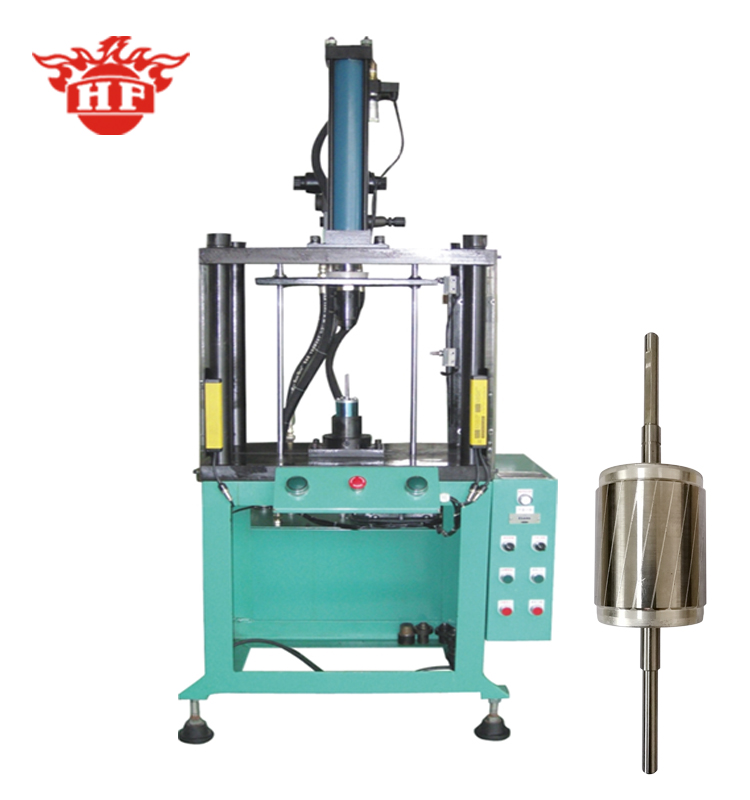
New Rotor and Shaft Inserting Hydraulic Press Machine HF-W50
- 1-Year Warranty & heavy cast-iron frame
- Precision interference fit alignment
- Preserves bearing journal concentricity

Hot Sale Armature Winding Machine for Fan Motor
- High-speed flyer winding mechanism
- Auto tensioner prevents enamel cracking
- Ideal for DC & universal rotor armatures

Slot Paper Inserting Cutting Machine 1kW 380V/220V
- Auto creasing, feeding, cutting & insertion
- Compatible with table fan, cooler & pumps
- Zero edge damage on stator lamination

HF-R40-2G Ceiling Fan Stator Winder (Two Controllers)
- Independent dual-station motor operation
- High turns precision with digital readout
- 1-Year warranty & quick-change fixtures

HF-W120H Stator Coil Final Forming Shaping Machine
- Hydraulic internal/external expanding blocks
- Calibrated end-turn clearance for rotor insertion
- Robust heavy structure for long-term rigor

HF-LO2-6G Six Stations Internal Winding Machine
- Dedicated inner stator winding automation
- Integrated PLC indexing with servo drives
- Multi-pole simultaneous winding capability

New HF Fan Motor Rotor Turning & Surface Machine
- PLC surface cutting & aluminum fine trimming
- Integral coolant pump system for clean edges
- Maintains exact stator-rotor air gap tolerance

HF-R40-2C Automatic Ceiling Fan Coil Winder
- Compact dual-head configuration for volume run
- Handles copper and enameled aluminum wire
- CE electrical safeguard conformity built-in
Engineering Stator Automation for Fukuoka's Modern Industrial Fabric
As the automotive, robotics, and precision manufacturing gateway of Kyushu—known historically as "Silicon Island" and "Car Island"—Fukuoka Prefecture drives strict requirements for energy efficiency, motor compactness, and high-mix automation.
Technical Demands in Northern Kyushu: From Robotics to Automotive Electrification
Fukuoka and surrounding municipalities like Kitakyushu, Kanda, and Kurume represent one of East Asia's most sophisticated electromechanical clusters. Plants operating in this sector produce servo motors for articulation arms, compact brushless DC (BLDC) motors for factory automation, and auxiliary drive motors for hybrid and battery-electric vehicles (EVs). Sourcing stator winding and assembly equipment for this market is not merely about mechanical wire placement; it centers on three uncompromising engineering criteria:
1. Slot Fill Factor Optimization & Partial Discharge Inception Voltage (PDIV): In servo and automotive auxiliary motors operating under inverter pulse-width modulation (PWM) switching frequencies, irregular winding turns cause localized voltage spikes that degrade slot insulation paper. Our high-precision multi-axis flyers and internal stator winders (such as the HF-LO2-6G) ensure stratified winding layers without overlapping wire cross-overs. This maintains uniform inter-turn capacitance and maximizes copper fill factors above 78% while preserving insulation enamel integrity.
2. Mechanical Compatibility with 60Hz Power Grids: Western Japan—encompassing Fukuoka and the Kyushu Electric Power grid—operates strictly on a 60 Hz AC grid. Industrial plants generally run on 200V 3-phase, differing both from Eastern Japan's 50 Hz grid and continental 380V/400V supplies. All equipment exported by Zunqi Intelligent Equipment is engineered with multi-voltage transformers or native 200V 60Hz servo power packs, preventing thermal degradation in motors and ensuring clock-cycle synchronization on servo drives without harmonic distortions.
3. Direct Integration with CE & JIS Machinery Directives: Japanese Tier-1 and Tier-2 manufacturers demand full mechanical and electrical risk assessment compliance under JIS B 9700 (harmonized with ISO 12100) alongside CE Machinery Directive 2006/42/EC and Low Voltage Directive 2014/35/EU. Our equipment integrates category-3 safety circuits, dual-channel emergency stop architectures, optical light curtain interfaces, and interlocked enclosure guards that allow immediate installation in Japanese plant cells.
| Motor Process Step | Standard Machine Model | Core Technical Parameter | Fukuoka Production Line Benefit |
|---|---|---|---|
| Slot Paper Insertion | HF-D50 / Table Series | Feed length: 15–120mm; Speed: 0.5–1.0s/slot | Zero burr shearing on Nomex/DMD; prevents ground faults |
| Internal Stator Winding | HF-LO2-6G (6 Stations) | Wire Dia: 0.12–1.2mm; 6-station rotary indexing | High-volume BLDC and servo stators with compact coil heads |
| Coil & Wedge Insertion | Coil-Wedge Auto Combo | One-stroke push-in for wire bundle & slot wedge | Cuts human labor by 85%; eliminates wire scraping risks |
| Coil Forming (Shaping) | HF-W120H Hydraulic | 2nd-stage expanding shaping; 3-5 MPa clamping force | Secures precise air-gap clearance before rotor insertion |
| Rotor Shaft Pressing | HF-W50 Hydraulic Press | 5–10 Ton controlled thrust; ±0.01mm displacement | Prevents shaft micro-deflection in precision fan/pump rotors |
| Rotor Fine Turning | HF-C60 Lathe Unit | Surface finish Ra < 0.8μm; run-out ≤ 0.015mm | Reduces magnetic cogging torque & operational acoustic noise |
Fukuoka & Kyushu Industrial Application Scenarios
Engineered to support regional manufacturing subsectors across northern Kyushu's automotive corridor and industrial zones.
Automotive Auxiliary & EV Sub-Assemblies
Applied in Miyako, Kanda, and Kitakyushu automotive supply parks. Our winding, inserting, and shaping systems fabricate high-density stators for electric power steering (EPS) motors, electronic water pumps (EWP), radiator fans, and air conditioner compressors operating under rigorous thermal cycles.
Robotics & Industrial Servo Motors
Supporting automation equipment builders in Yahatanishi and Kurume. The multi-station internal winding systems provide high turn-count repeatability and precise end-turn shaping for high-dynamic AC servo motors that require minimal cogging torque and balanced back-EMF.
Commercial HVAC, Pumps & Blowers
Installed across northern Kyushu pump fabricators and ventilation fan workshops. Our slot paper inserters, coil wedge inserting units, and automated rotor turning machinery process continuous runs of IEC and JIS-standard frame stators with minimal changeover downtime.
Future Trends Shaping Motor Line Procurement in Western Japan
Understanding macro-shifts enables procurement directors to design flexible, future-proof production facilities.
Top Runner Program & IE4/IE5 Compliance
Under Japan's Energy Conservation Act, industrial motors must meet stringent efficiency benchmarks (Top Runner Program). Achieving IE4 and ultra-premium IE5 performance requires tighter lamination slot tolerances, lower copper losses, and accurate winding tensioning to prevent strand elongation.
Overcoming the Skilled Artisan Deficit
Aging technical workforces across Kyushu make manual coil lacing, manual wedge tapping, and hand-insertion unsustainable. Fully automated, single-stroke inserting machines transfer operator dependencies to reliable PLC algorithms and precision CNC tooling.
Shift Toward Modular Cell Manufacturing
Japanese producers are increasingly transitioning from massive monolithic lines to agile, compact automation cells. Our modular stand-alone units allow factory managers in Fukuoka to flexibly scale from slot paper inserting to final shaping as demand increases.
Why Japanese Engineers & Importers Partner with Zunqi Intelligent
Combining 17+ years of international manufacturing excellence with custom tooling flexibility.
Tooling Tailored to Drawings
Every winder nozzle, insertion blade, and forming mould is CNC-machined to your exact lamination drawings or physical stator samples. We execute trial runs in Dongguan and deliver complete sample winding videos before dispatch.
Turnkey Compatibility
From initial slot paper lining to final rotor turning and shaft pressing, our entire series uses matched cycle times and standardized interfaces, avoiding mismatches between upstream and downstream machinery.
Full Support & 1-Year Warranty
All machinery comes with a comprehensive 1-year warranty, video-guided parameter tuning, long-term wear part availability, and fast response times averaging under 9 hours.
Configurable Japanese & Global Industrial Automation Components
We integrate control hardware according to your factory's standardization protocols, minimizing inventory overhead for plant maintenance teams in Japan:
Frequently Asked Questions by Japanese Technical Buyers
Detailed answers covering grid adaptation, logistics to Hakata Port, tooling customization, and compliance.
Can your machines be configured for Fukuoka's 200V 60Hz 3-phase electrical supply?
Yes, absolutely. Western Japan operates on a 60Hz grid, typically at 200V 3-phase or 100V/200V single-phase. Before factory assembly, our electrical design team confirms your plant's exact operating voltage and frequency. We fit native 200V 60Hz servo motors and transformers, tune servo frequency filters to avoid resonance, and configure industrial PLC power units to guarantee seamless startup without localized line-voltage step-up transformers.
How does CE certification align with Japanese factory safety standards (JIS)?
Our CE certified machinery conforms strictly to harmonized European standards, including EN ISO 12100 (Safety of Machinery - General Principles for Design) and EN 60204-1 (Safety of Machinery - Electrical Equipment of Machines). Because Japanese Industrial Standards (notably JIS B 9700 and JIS C 9920-1) are harmonized with these identical ISO/IEC international baselines, our CE documentation, dual safety relays, interlocked guards, and risk assessments satisfy internal plant health and safety reviews across Japanese manufacturing facilities.
What are the shipping routes, customs transit times, and delivery arrangements to Hakata Port?
From our manufacturing center in Dongguan, equipment is transported via direct maritime freight from Shenzhen (Yantian/Shekou) or Guangzhou to Hakata Port (Fukuoka) or Kitakyushu (Moji Port). Direct ocean transit usually requires only 4 to 7 days. All machines are packed in export-compliant, fumigation-free solid plywood crates, thoroughly vacuum-sealed in VCI anti-corrosion film, and secured with internal floor tie-downs to ensure zero shifting or saltwater vapor exposure during sea crossing.
How do we verify customized tooling for non-standard stator laminations?
During the quotation and technical engineering review, clients submit their 2D/3D stator drawings showing inner diameter (ID), outer diameter (OD), stack height, slot dimensions, and wire winding schematics. We strongly advise sending physical stator core laminations to our test workshop. We fabricate custom winding nozzles, push blades, and forming dies, test-run them on the equipment, and supply high-resolution video recordings and dimension verification reports of the wound stator for formal sign-off prior to crating.
What after-sales service and replacement parts support is available for plants in Kyushu?
We provide full remote engineering support via high-definition video conferencing for setup, calibration, and parameter optimization. An initial spare parts package (including winding needles, cutter blades, push-rod fingers, and pneumatic seals) is crated with each machine. Furthermore, because we configure electrical systems with globally accessible components (such as Mitsubishi, Omron, and SMC), standard consumables can be sourced directly through your local Japanese industrial distributors, eliminating line downtime.
Plan Your Fukuoka Stator Production Line with Engineers
Whether you require a single semi-automatic ceiling fan stator winder, a 6-station inner stator winder, or a fully synchronized automated inserting and lacing cell, our engineering team responds within 9 hours with equipment selection, tooling blueprints, and pricing.
