
Export-Grade Machinery
Essential Stator Assembly & Machining Systems
Engineered for high duty-cycle performance, vibration resistance, and seamless tooling adaptation for induction, compressor, and traction motor production.






17+
Years International Trade Experience
51–100
Specialized Engineers & Technicians
≤ 9h
Mean Engineering Response Window
100%
Customized Stator Tooling Prototyping
Industrial Context: Stator Automation Engineering in Vitebsk
As one of Belarus's established centers for heavy electrical machinery, instrument manufacturing, and industrial automation equipment, Vitebsk demands rigorous operational standards for electromagnetic coil processing. Production engineers across the Vitebsk Region are confronted with accelerating requirements for operational energy efficiency (equivalent to IE3 and IE4 continuous duty norms) while navigating harsh operational ambient environments and rigorous Eurasian Economic Union (EAEU) technical safety frameworks.
Automatic stator coil lacing represents an essential, non-negotiable step in maintaining the mechanical integrity of high-voltage and low-voltage induction motors. During electromagnetic transients, high-amplitude inrush currents exert severe Lorenz forces across overhang coil end-turns. In manual or semi-consistent binding procedures, uneven lacing tension causes microscopic rubbing against slot edges, premature degradation of class F or H enameled insulation layers, and eventual turn-to-turn dielectric breakdown.
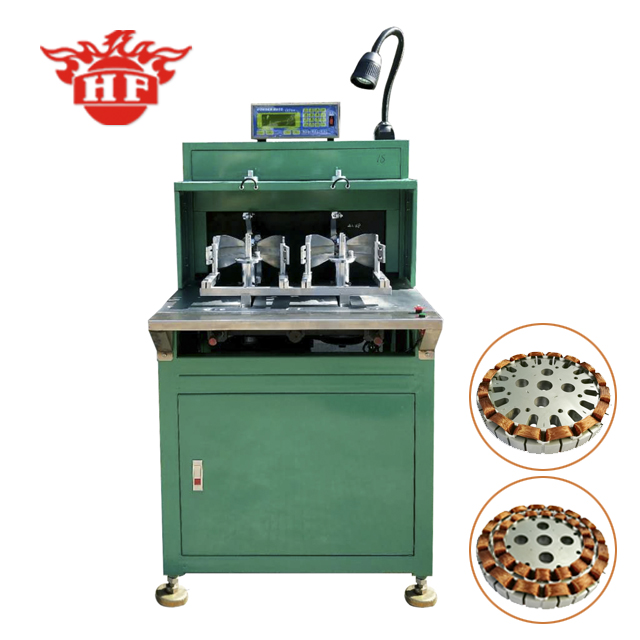
Supplying the Vitebsk market, our automated double-sided and single-sided stator lacing systems eliminate axial and radial end-turn migration through continuous, multi-axis servo-driven needle synchronization. By automating lacing pitch, stitch tension, and slot indexing across complex slot geometries (from 8-slot miniature blowers to 72-slot heavy traction machinery), we provide manufacturers with repeatability unachievable through manual labor.
Technical Specification Architecture: Automatic Double-Side Lacing Units
To maintain interoperability with existing Vitebsk factory lines, our machinery incorporates robust mechanical designs combined with widely serviced, internationally certified industrial control automation.
| Engineering Metric | Standard Capability | Heavy-Duty Industrial Option |
|---|---|---|
| Stator Core Outer Diameter (OD) | ∅ 40 mm – ∅ 160 mm | Up to ∅ 260 mm (Custom Tooling) |
| Stator Core Stack Height | 10 mm – 150 mm | Customized up to 250 mm |
| Lacing Method / Style | Slot-by-slot, interval slot, fancy lacing | Programmable via industrial HMI touchscreen |
| Binding Pitch / Needle Cycle | 0.45 – 0.70 seconds per stitch | Servo synchronized needle & hook mechanism |
| Lacing Tension Adjustment | Mechanical damper control (10–35 N) | Closed-loop dynamic pneumatic/servo tensioning |
| Pneumatic Air Requirement | 0.5 – 0.7 MPa (Dry, filtered air) | Integrated SMC/Airtac moisture separation |
| Configurable Control Systems | Mitsubishi / Delta PLC & Inovance Servos | Siemens S7-1200 / Omron Architecture |
Production Environments
Vitebsk Manufacturing Application Profiles
Engineered to fit specific motor assembly configurations common across industrial workshops, retrofitting operations, and Tier-1 sub-assembly centers.
Hermetic Refrigeration & HVAC
Compressor motors operating within sealed freon or ammonia systems require zero particulate contamination and tight end-winding overhang tolerances. Our lacing heads apply synthetic fiber ribbons with burr-free needle passage, preventing frayed cords from fouling thermal expansion valves.
Heavy Pumps & Submersible Drives
Agricultural and municipal submersible pumps experience severe vibration during continuous cavitation transients. Automated double-sided lacing locks phase separators tightly against winding groups, ensuring resin impregnations (VPI) penetrate uniformly without internal air voids.
Industrial Machine Tool Actuation
Precision lathe, milling, and grinding spindles produced in Vitebsk depend on compact stator envelopes. Our pre-forming and lacing synchronization achieves low-profile coil overhangs, permitting motor designers to shrink end-bracket volume while preserving thermal dissipation performance.
Regional Technological Trajectory: Automated Stator Lines in Eastern Europe
Motor manufacturers across Vitebsk and neighboring industrial zones are facing a generational shift: experienced manual winding personnel are aging out of the workforce, while market competition mandates faster cycle times and consistent adherence to zero-defect quality thresholds. The transition from manual binding to semi-automated and fully synchronized CNC lacing cells addresses three structural hurdles:
Elimination of Human Tension Drift
Manual tying inevitably suffers from operator fatigue over an eight-hour shift. Inconsistent knot tension allows individual copper conductors to vibrate under 50 Hz/60 Hz line frequencies, causing micro-abrasion of the enameling over time.
High-Speed Tooling Adaptability
Contract motor builders often produce varied, smaller production runs. Modular indexing plates and fast-change needle tooling reduce stator reconfiguration time from full shifts down to less than 45 minutes.
Integration with Upstream Forming
Lacing cannot be treated as an isolated workstation. Direct mechanical compatibility with intermediate expanding tools and final sizing presses ensures that coil heads will not strike bearing housings during final motor housing press-fit.
Enterprise Core Competence
Why Vitebsk Procurement Teams Choose Our Equipment
Direct-from-factory engineering integrity backed by 17 years of specialized motor manufacturing machine exports.
1-to-1 Stator Tooling Prototyping
We design and machine dedicated cam tooling, insertion blades, and lacing arms based precisely on your stator drawing or physical sample before delivery acceptance.
Complete Stator Line Matching
From insulation paper insertion and high-speed coil winding to coil wedge placement, middle forming, lacing, and final expanding, our systems maintain unified cycle timing.
Industrial Control Architecture
Configurable hardware architecture incorporating Siemens, Mitsubishi, Omron, or Delta components ensures plant electricians can troubleshoot and source parts locally.
Heavy-Duty Export Packaging
All equipment shipped to Vitebsk undergoes vapor corrosion inhibitor (VCI) preservation, chassis bolt-down anchorage, and fumigation-free solid timber crating for long-haul transit.
Procurement Clarity
Frequently Asked Questions for Vitebsk Buyers
Practical insights addressing power compatibility, logistical handoffs, spare tooling, and after-sales support.
Can the machine operate on Belarus electrical network standards?
Yes. While standard domestic Chinese factory production utilizes 380V/50Hz 3-phase or 220V/50Hz single-phase systems, we configure power supplies, servomotors, transformers, and breaker panels to match Vitebsk factory grids (380V ± 10%, 50Hz, 3-phase, 4-wire or 5-wire grounding networks). Control circuits operate on clean, isolated 24V DC to safeguard PLCs against voltage spikes.
What specific stator dimensions and parameters are required for a customized tooling quote?
To fabricate matched needle tooling and positioning clamps, our engineering team requires: stator lamination outer diameter (OD), inner bore diameter (ID), core stack height, number of slots, slot opening width, wire diameter (including enameled coat thickness), and target coil overhang height limits. Providing a 2D/3D CAD drawing (.DWG or .STEP) or dispatching 1–2 physical lamination cores ensures guaranteed tooling verification before shipping.
How is installation, setup, and operator training managed remotely in Vitebsk?
Each unit ships fully assembled and pre-calibrated. Before dispatch, we provide a complete trial-run HD video operating on your exact stator specifications. Upon arrival, we furnish step-by-step schematics, operational manuals in English/Russian, and coordinate dedicated real-time video commissioning conferences. For complete, turn-key automated stator lines, on-site commissioning technicians can be arranged.
What types of lacing materials (thread/tape) are supported?
Our automatic lacing needle assemblies handle polyester cords, nylon lacing ropes, Nomex heat-resistant tapes, and braided fiberglass bindings with linear densities ranging from 1000D to 3000D. The mechanical guide paths feature ceramic eyelets to prevent cord shredding under high tension.
What is the typical shipping cycle and freight method to Vitebsk?
Equipment is packaged in heavy-gauge sea/rail crates. Shipments to Vitebsk are typically routed via direct China-Europe Railway Express (multimodal container rail freight) or via major transit hubs with onward road delivery. Typical transit time is 18 to 28 days depending on customs routing.
What is your policy on warranty, replacement parts, and wear components?
All automatic coil lacing and stator production machinery comes with an unconditional 1-year warranty on core structural and electromechanical components. A dedicated consumable kit containing spare lacing needles, cutting blades, return springs, and pneumatic fittings is packed inside the machine crate. Replacements can be dispatched via international express air within 48 hours.
