Precision Stator Coil Inserting & Winding Machines
Explore our battle-tested lineup of automatic coil & wedge inserters, multi-station internal winders, and rotor finishing stations engineered directly from our Dongguan automation facility.

Coil & wedge Paper Inserting Machine
- Simultaneous copper wire & wedge feeding
- Custom tooling for variable slot depths
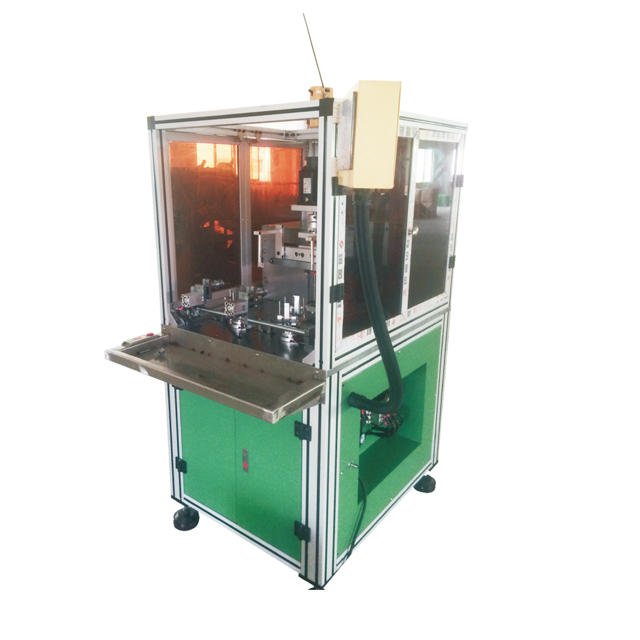
4 stations internal Stator Winding Machine
- Continuous rotary indexing mechanism
- High-speed internal needle winding head

HF-LO2-6G Six Stations Internal Winding Machine
- PLC and Engine Control System
- Mass throughput for inner stator cores

Automatic Servo System Stator Coil & Wedge Inserter
- Dual-axis servo synchronized insertion
- Zero enamel scratch push blade setup

Automatic Fan Motor Coil & Wedge Inserter
- Optimized for high-speed appliance stators
- Rugged gear & cam transmission modules
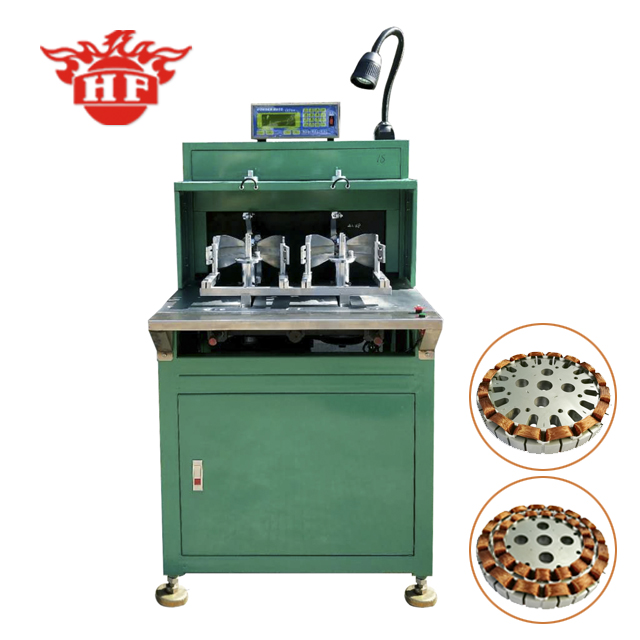
Automatic Ceiling Fan Two Station Winding Machine
- Dual independent controller architecture
- Simultaneous double-core cycle output

Fan Motor Rotor Rough Turning Cutting Machine
- Engine Gear and PLC core components
- High-torque lamination surface shaving

Rotor Fine Turning Cutting Machine HF-C60
- Precision OD finishing for tight air gaps
- Coolant pump & vibration isolation
The Mechanics of Synchronous Coil and Slot Wedge Insertion
In modern induction and permanent magnet electric motor manufacturing, stator coil inserting represents the most mechanically sensitive process. Understanding tooling kinematics, wedge profiling, and magnetic slot fill limits is vital to eliminating insulation breakdowns.
Simultaneous Stroke Dynamics
Traditional split insertion methods push phase winding groups first, followed by a separate cycle for slot wedges. Our synchronous one-stroke insertion technology utilizes a precision-guided tooling magazine where the wedge pusher and coil push blades advance in synchronized concert. By aligning the entry of the slot insulation wedge (DMD, Nomex, or polyester film) directly behind the ascending copper bundle, wedge guides maintain slot mouth clearance and prevent turn crossovers.
This synchronized motion eliminates intermediate wire re-expansion, minimizing physical friction against the lamination punch edges and keeping insertion force curves strictly linear.
High Slot Fill Factor (>75%)
Achieving IE3, IE4, and Super Premium efficiency standards requires maximum copper packing density. Standard insertion machinery often causes severe enamel scraping when slot fill ratios exceed 70%. Our custom OEM inserters employ hard-chromed DC53 and SKD11 tool steels polished to mirror finishes (Ra ≤ 0.05 μm).
Micro-tapered blade tips and radius-contoured wedge expanders gently guide multi-strand wire groupings into narrow slot openings without scraping off polyimide-imide outer coatings, ensuring robust dielectric performance under steep PWM inverter drive transients.
Precision Wedge Feeding & Creasing
A flawed slot wedge invites creepage flashovers. Our automated feeding mechanism performs real-time continuous decoiling, edge-scoring, precision fold profiling, cutting to programmable length (±0.2mm), and insertion positioning.
By controlling feed roller tension and punch die clearance, the system preserves structural elasticity in the wedge ears, allowing them to snap securely behind the tooth lip overhangs to lock down the conductor bundles against high rotational centrifugal forces.
| Stator Parameter / Requirement | Standard Mechanical Cam Machine | Zunqi Advanced OEM Servo Inserter | Engineering Benefit |
|---|---|---|---|
| Maximum Slot Fill Ratio | 62% – 68% Max | 72% – 78% | Higher motor torque density & energy efficiency tier |
| Wire Material Compatibility | Copper Only (Strict Limits) | Enamelled Copper & Aluminium Wire | Flexibility for high-volume cost-optimized fan/pump motors |
| Tooling Steel Grade | Cr12 Standard Tool Steel | Vacuum Quenched DC53 & SKD11 (>HRC 60) | Extended tool life up to 1.5 million insertion cycles |
| Wedge Cut Length Repeatability | ±0.8 mm | ±0.2 mm (Servo-Driven Feed) | Flawless slot closure without overhang into end-turn forming dies |
| Cycle Time (36-Slot Stator) | 35 – 45 Seconds | 18 – 26 Seconds | Up to 45% productivity improvement on production lines |
Technological & Procurement Trends in Stator Automation
As the global motor industry transitions rapidly toward permanent magnet synchronous motors (PMSM), electric mobility, and IoT-enabled predictive smart plants, procurement criteria for coil insertion machinery are evolving fundamentally.
Technological Development Trends
1. Transition to All-Electric Closed-Loop Servo Drives: Traditional hydraulic or pneumatic ram cylinders are being replaced by multi-axis coordinated servo systems. Closed-loop torque feedback monitors insertion pressure curves in real time. If a misaligned blade detects unexpected resistance (>15% deviation), the ram halts within milliseconds, completely preventing costly tooling crashes and scrapped stator stacks.
2. Quick-Change Modular Cartridge Tooling: The rise of high-mix low-volume production requires changeover times to plunge from hours to under 20 minutes. Modern machines adopt quick-coupling tool modules where the pusher, wedge guides, and magazine basket lock into position via datum dowel pins without requiring tedious micrometer recalibration.
3. Traceability & Smart Factory Digitalization: Today's procurement specs mandate OPC-UA or Modbus TCP network integration. Stator insertion data—including peak thrust, cycle timestamp, slot wedge feed rate, and operator ID—are streamed to plant MES systems for ISO 9001 compliance and automated batch tracking.
Future Procurement Trends
1. Turnkey Matched Ecosystems over Fragmented Sourcing: Procurement teams are consolidating vendor relationships. Purchasing a winding station from Vendor A and an inserter from Vendor B frequently causes finger-pointing when coil head heights exceed intermediate forming boundaries. Sourcing matched turnkey cells—from insulation paper insertion to final rotor dynamic balancing—ensures unified cycle-time matching.
2. Total Cost of Ownership (TCO) Prioritization: Smart procurement directors now assess TCO over 5-year operating windows rather than initial purchase price alone. Critical evaluation factors include spare blade availability, international brand accessibility for components (e.g., Siemens PLC, Schneider breakers, SMC pneumatics), and standardized consumable cost.
3. Rigorous Virtual Factory Acceptance Testing (FAT): Supply chain risks have elevated virtual FAT protocols. Global buyers require full video run-off tests on their specific stator samples, analyzing high-speed microscopic footage of post-insertion wire enamel integrity prior to export crating.
Why Global Motor Manufacturers Partner With Zunqi
Located in Dongguan's advanced industrial core, Zunqi Intelligent Equipment Co., Ltd. combines seventeen years of specialized export excellence with in-house custom engineering capability.
17+ Years Export Track Record
Our verified manufacturing base at No.2 Dongshan Yongchang Road, Qishi Town, has served electric motor workshops across Europe, North America, Southeast Asia, and the Middle East. With an established annual export turnover of US$2.5M – US$5M and an onsite-checked supplier credential on Alibaba.com, we guarantee audited financial and operational stability.
Tailored Tooling to Your Stator Sample
We do not provide generic off-the-shelf compromises. Every inserting magazine, pusher horn, guide finger, and blade assembly is custom-machined via slow-wire EDM and 5-axis machining centers to your specific stator drawing (OD, ID, stack height, slot dimensions, and wire bundle specifications). We validate tooling on physical samples provided by you prior to crating.
Open Component Architecture
We understand factory standardization. Our engineering department freely configures the electrical control and pneumatic topology to match your factory maintenance inventory: Siemens, Mitsubishi, Delta, Panasonic, Omron, Schneider, SMC, or Airtac. This eliminates regional spare part lead time bottlenecks and facilitates seamless integration.
Turnkey Stator Production Line Coverage
From entry slot paper inserting machines through multi-spindle coil winding, simultaneous coil & wedge inserting, coil intermediate forming, dual-head servo lacing, and final dimension sizing, Zunqi designs every step to harmoniously balance cycle times across your entire shop floor.
Rapid Response & Remote Support
With an audited average inquiry response time of ≤ 9 hours, our bilingual mechanical and software engineering staff provides comprehensive remote video commissioning, parameter debugging, wiring schematics, and lifetime wear-part supply support.
Heavy-Duty Export Packaging
Every single machine undergoes full degreasing, VCI anti-rust oil treatment, vacuum moisture-barrier barrier shrink wrapping, and bolt-fastened anchoring inside custom fumigation-free plywood shipping crates built specifically to withstand ocean transit humidity.
Integrated Stator Manufacturing: The 8-Stage Process
To achieve low PPM defect rates and minimize labor costs, stator winding and insertion must be viewed as an interconnected mechanical ecosystem. Here is how our equipment harmonizes the line.
Slot Insulation
Automatic feeding, creasing, cutting, and high-speed insertion of insulation paper liners into every stator slot, preventing direct lamination contact.
Coil Winding
Multi-spindle or flyer winding of enamelled wire into precision step transfer cups, maintaining strict turn count accuracy and constant line tension.
Coil & Wedge Insertion
The core process: simultaneous pushing of coils and profiled slot closure wedges into stator slots via custom-guided push blades.
Intermediate Forming
Pre-forming of the stator coil end turns expanding outward to ensure adequate rotor clearance and prepare geometry for lacing needle access.
Dual-Side Lacing
Simultaneous servo binding of both end windings with high-strength cord using programmable stitch spacing, locking windings against vibration.
Final Coil Sizing
Hydraulic or servo volumetric pressing of the coil heads into final dimensional tolerances, ensuring exact fit inside end-bell housing envelopes.
Rotor Surface Turning
High-speed fine turning of the rotor outer diameter to ensure tight, uniform magnetic air gaps between the stator bore and rotor core.
Shaft Press Fitting
Force-monitored hydraulic shaft insertion into the rotor pack, preserving run-out tolerances and guarding bearing journal surfaces.
Frequently Asked Questions by Technical Procurement Teams
Get authoritative answers on machine capabilities, customization boundaries, tooling durability, and worldwide commissioning support.
What parameters are required to quote a custom OEM stator coil inserting machine? +
Can a single coil inserting machine handle multiple stator models? +
How does your machinery eliminate enamel wire scratching during high fill-factor insertion? +
Can your machines process both copper and aluminium magnet wire? +
What is the minimum order quantity (MOQ) and lead time for customized equipment? +
What warranty, after-sales service, and spare parts support do you provide internationally? +
Accelerate Your Stator Line Efficiency Today
Send your stator CAD drawings, core sample dimensions, and daily production targets to our Dongguan engineering department. We evaluate feasibility and provide comprehensive machine proposals with tooling drawings within 9 hours.
Send an Inquiry