
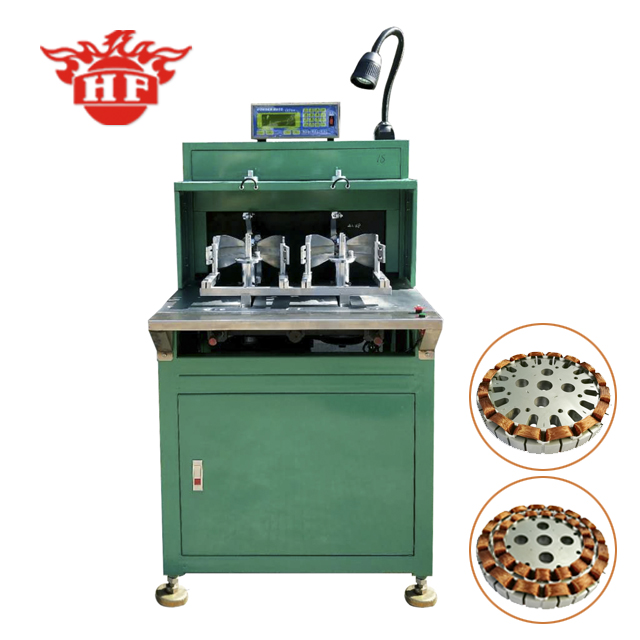
HF-R22 Semi-Automatic Coil Winding Machine (8 Heads)
- • Suitable for Fan, Cooler, Pump Motors
- • High-speed synchronized winding stations
- • Microcomputer wire pitch control
Direct factory-to-workshop automation. Each unit is customized according to stator slot geometry, lamination stack height, and target tact times for pumps, fan motors, power tools, and compressor production.






In modern electric motor manufacturing, the stator insulation process serves as the primary barrier against inter-turn phase faults and ground shorts. Analyzing cold-forming parameters, paper edge folding, and insertion forces is critical for production reliability.
Automated stator paper inserters execute precision mechanical creasing to fold both axial edges of the insulation film (typically DMD, NMN, or Nomex composite). Hemming reinforces axial tear resistance as coils are pressed into the slot, preventing flashover risks along lamination burrs.
The cross-sectional contour of the formed paper must correspond to the tooth profile. Under-forming causes the slot liner to buckle inwardly, constricting the usable cross-sectional slot area (slot fill factor), whereas over-forming risks radial misalignment during automated insertion.
In Variable Frequency Drive (VFD) applications, rapid dV/dt transient pulses subject the slot liners to high electrical stress. Precision machine indexing ensures that zero microscopic pinching occurs along the core ends, protecting baseline insulation resistance beyond 500 MΩ at 1000V DC.
As global energy efficiency standards escalate to IE4 and IE5 (IEC 60034-30-1) and electric mobility expands, tier-one motor factories are reshaping their equipment procurement criteria.
| Evaluation Parameter | Legacy Machine Systems | Next-Gen Intelligent Equipment (2025+) | Impact on Total Cost of Ownership (TCO) |
|---|---|---|---|
| Drive Architecture | Cam-driven pneumatic indexing with mechanical gears | Multi-axis synchronized AC servo drives with dynamic torque loop | Reduces tooling setup wear by 42%; cuts job changeover time from 120 to 15 minutes. |
| Thermal Class Handling | Standard Class B/F papers (Polyester films, DMD) | Ultra-tough Class H/N papers (Aramid Nomex, Kapton, Polyimide) | Zero wrinkling on high-stiffness papers, preventing scrap rates during EV motor production. |
| Slot Fill Optimization | Fixed slot clearance (fill factor restricted to 65-72%) | Micro-thin cuff forming allowing tight magnetic slot packing (>80%) | Decreases active copper usage while improving motor torque output per volume. |
| Traceability & IIoT | Standalone PLC with basic mechanical counters | OPC-UA/MQTT protocol integrated with industrial MES systems | Enables real-time tracking of push-force profiles to identify lamination burrs before winding. |
Purchasers now require quick-change modular cassette dies. Standardizing push blades and guide fingers allows plants to switch stack height and slot diameter across frame sizes (e.g., IEC 71 to 132) without capital investment in secondary machinery.
Procuring paper inserters, coil winders, wedge insertion stations, intermediate formers, and dual-side lacing systems from a single manufacturing partner eliminates interface bottlenecks between separate vendor automation protocols.
Plant maintenance managers actively seek Chinese OEMs capable of engineering native electrical cabinets using universally stocked components (Siemens, Mitsubishi, Schneider, SMC, Omron), securing low lifecycle replacement costs.
Driven by the demands of renewable energy systems, heat-pump variable speed compressors, and automotive electrification, stator manufacturing machines are undergoing a structural evolution.
While traditional distributed windings use slot paper insertion followed by coil shooting and wedging, modern concentrated winding designs utilize CNC multi-axis needle winding directly onto segmented tooth cores. Insulation machinery adapts by pre-applying injection-molded slot shoes or multi-cavity folded sleeves.
For rectangular copper wire (Hairpin) stators, slot liners must undergo cold precision B-type or S-type folding. High mechanical precision is required to ensure that each individual copper conductor is separated by consistent dielectric sheets without exceeding slot width clearances.
Integrated industrial machine vision systems detect lamination slot alignment before the insertion mandrel executes. Real-time vision checks prevent bent lamination teeth and detect misfolded paper cuffs, automatically rejecting anomalous stators before the winding and lacing phases.
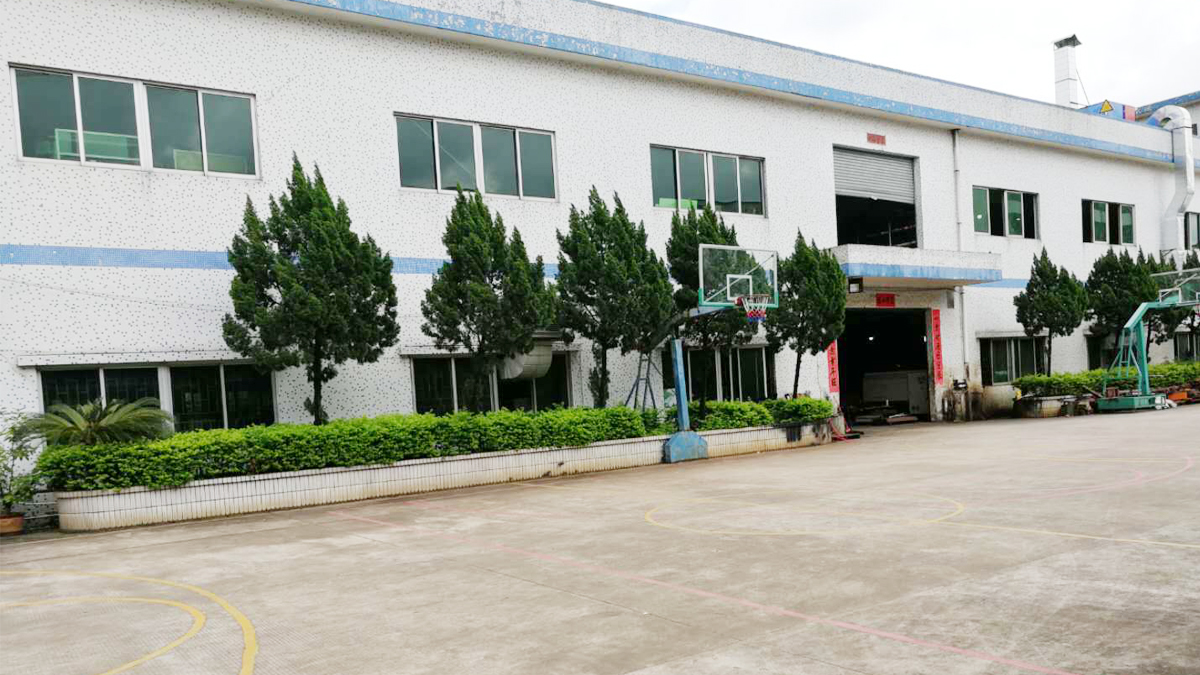
Located at Qishi Town, Dongguan, Zunqi Intelligent Equipment Co., Ltd. operates in South China's electrical machinery manufacturing hub. We provide international motor plants with direct engineering and validated quality control.
We do not ship generic off-the-shelf configurations. Every paper-forming die, coil winder mold, and lacing carriage is engineered from your stator 2D/3D CAD drawings and validated on your physical core samples prior to dispatch.
Backed by full onsite verification and an established export track record across Europe, the Middle East, Southeast Asia, and the Americas, our operations offer verified supply safety and structured international logistics support.
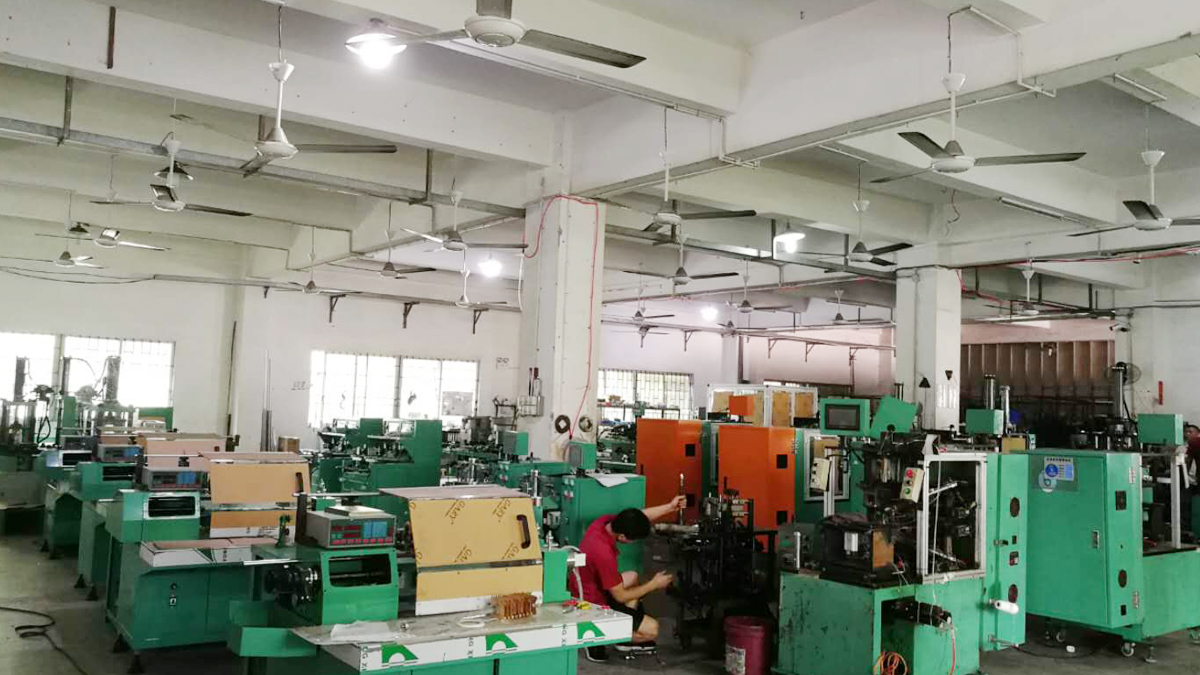
Every machine undergoes rigorous continuous-cycle testing in our assembly bay using customer-supplied wire and lamination stacks. Clients receive high-definition operational video verification before dispatch crates are secured.

Clear technical answers to help manufacturing, quality, and procurement teams prepare engineering specifications and plan line integration.
To provide an accurate technical quote and tooling quotation, our engineering team requires: (1) 2D/3D stator lamination drawings indicating slot shape, outer diameter (OD), inner diameter (ID), and number of slots; (2) Core stack height range (min/max mm); (3) Insulation material type (DMD, NMN, polyester, Nomex) and total thickness; (4) Required edge cuffing specifications (single cuff or double cuff, folded width); and (5) Your required cycle time per stator.
Yes. Stator stack heights within the same series can be adjusted via servo-driven push strokes and digital touchscreen parameter changes without replacing major tooling. When transitioning between stators with different internal diameters or slot numbers, modular tooling changeovers (including the rotary indexing table, pushing pushers, and paper guide tracks) can be completed in under 20 minutes.
Our machines integrate adjustable double-roller mechanical creasing mechanisms that pre-fold paper edges before forming. Guided by CNC-machined tungsten carbide or SKD11 tool-steel guide plates, paper edges remain relaxed during pushing. Servo feed controls minimize mechanical shock, maintaining intact cuffs even with brittle high-thermal-class composite films.
Machines are built with European and American safety protocols in mind, featuring optoelectronic light curtains, dual emergency stop circuits, shielded conduits, and interlocked transparent protective enclosures. Our electrical systems can be customized to local industrial utility standards, including 220V 1-phase or 380V/415V/480V 3-phase systems at 50Hz or 60Hz.
Every machine includes a comprehensive 1-year mechanical warranty. We supply interactive video setup guides, bilingual English/Chinese electrical schematics, and an initial set of wear-and-tear tooling parts. For production lines, PLC systems can be equipped with IoT communication modules for remote engineer diagnostics, parameter tuning, and troubleshooting assistance.
Submit your stator technical drawings to our Dongguan engineering team. Receive full machine configurations, line layouts, and commercial quotations within 9 hours.
Get Catalog