Precision Motor Manufacturing Equipment
Engineered to optimize slot fill rates, shorten production cycle times, and preserve copper wire insulation integrity.

Coil & Wedge Paper Inserting Machine

HF-R22 Coil Winding Machine Semi Automatic 8 Heads

HF-R40-2G Automatic Ceiling Fan Stator Winding Machine

Automatic Stator Wedge Paper and Coil Inserting Machine

HF Fan Motor Rotor Turning & Casting Machine

Fully Automatic Fan Motor Coil Winding Machine

New Fully Automatic Motor Coil Winding Machine
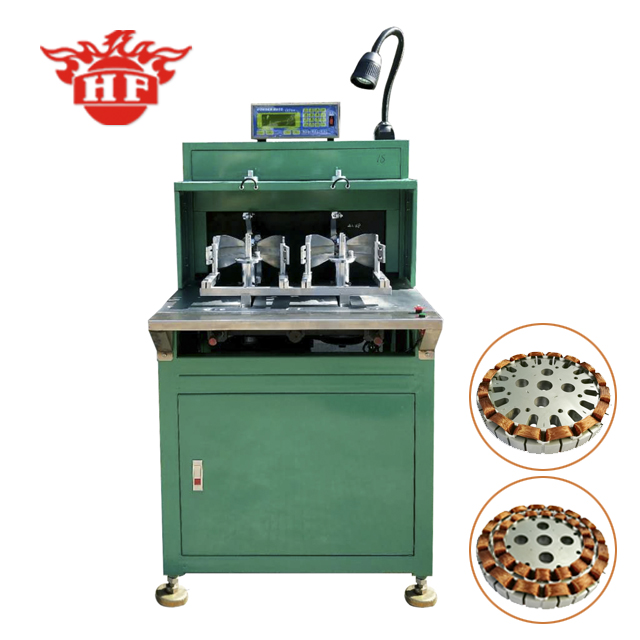
Automatic Ceiling Fan Winding Machine Two Station
Engineering Insights: Coil & Wedge Insertion Automation
A technical guide to eliminating slot insulation breakdown and maximizing stator slot copper fill rates.
1. Kinematic Mechanics: Synchronized Coil & Wedge Insertion
The manufacturing of electric motor stators requires micron-level precision during the coil inserting phase. A CE Certified Winding Insertion Machine solves the classic bottleneck of manual or semi-automated coil positioning: mechanical abrasion of enameled magnet wire. In modern induction, brushless DC (BLDC), and permanent magnet synchronous motors (PMSM), winding insertion machines deploy hardened steel insertion blades combined with pushing rods. The enamelled copper or aluminum coils and the pre-formed insulation wedges (manufactured from DMD, Nomex, or polyester film) are simultaneously driven into the stator core laminations in a single, controlled servo stroke.
By synchronizing blade progression with wedge guides, radial displacement of the slot insulation liner is completely prevented. This eliminates common dielectric failures, inter-turn shorts, and ground faults that occur when insulation paper is misaligned during unguided entry. Tooling surfaces undergo precision micro-polishing and thermal nitriding treatments to maintain a surface roughness under Ra 0.2, guaranteeing frictionless wire entry even under high slot-fill ratios exceeding 78%.
2. Complete Stator Assembly Production Flow
| Sequence | Process Station | Primary Machinery Used | Technical Functionality | Essential Tooling Parameters |
|---|---|---|---|---|
| Step 01 | Slot Cell Insulation | Stator Slot Paper Inserting Machine | Feeds, creases, cuts, and inserts cuff/edge liners | Lamination ID, slot count, core stack height |
| Step 02 | Electromagnetic Coil Winding | Automatic Multi-Head Stator Coil Winder | Winds enameled magnet wire into targeted jump patterns | Wire diameter (0.1–1.2 mm), coil turn counts |
| Step 03 | Coil & Wedge Insertion | Automatic Coil & Wedge Inserting Machine | Transfers coil loops and insulation wedges in one stroke | Stator inner diameter, slot opening width, blade count |
| Step 04 | Intermediate End-Turn Forming | Stator Coil Forming Machine (Pre-Forming) | Expands coil heads radially to ensure rotor bore clearance | Maximum allowable coil projection height |
| Step 05 | End-Turn Binding & Lacing | Single/Double-Side Servo Coil Lacing Machine | Ties and stabilizes winding overhang against harmonic vibration | Lacing pattern (slot-by-slot / skip slot), cord tension |
| Step 06 | Final Stator Sizing | Final Coil Forming Machine | Presses overhang boundaries to meet motor frame blueprints | Stator outer frame tolerance, lead wire exit channel |
3. Global Procurement Trends in Winding & Insertion Automation
The global transition toward high-efficiency industrial electric motors (meeting IEC 60034-30-1 IE3, IE4, and upcoming IE5 energy metrics) is directly dictating machine procurement specifications. Motor OEMs can no longer rely on loose manual insertion:
Transition to High Slot Fill Ratios: Next-generation industrial compressors, EV auxiliary drives, and heat pump motors demand maximum active copper volume within finite lamination dimensions. Winding insertion tooling must support tight-pitch winding insertion where the slot opening is narrow, necessitating ultra-thin, high-tensile alloy insertion fingers that resist elastic deflection.
Rise of Multi-Voltage and Dual-Wire Material Operations: Price volatility in raw copper has accelerated the adoption of aluminum magnet wire across HVAC, evaporative cooler, and ceiling fan lines. Modern inserting equipment must support seamless changeover between copper and aluminum without scraping the thinner oxide insulation layers characteristic of aluminum enameled wire.
4. Future Technology Trajectory: Servo-Electric Digitization & Modular Tooling
The winding insertion industry is aggressively moving away from legacy hydraulic and mechanical cam mechanisms toward all-electric multi-axis servo drives. Servo-actuated insertion provides real-time monitoring of thrust force curves. If an obstruction or wire crossover creates excess resistance inside a slot, the system halts instantaneously before the wire snaps or bends the stator teeth.
Furthermore, Industry 4.0 connectivity is now a standard baseline. Forward-thinking suppliers integrate OPC-UA communication interfaces and digital tool-change presets, reducing changeover downtimes from 3 hours to under 25 minutes. Quick-lock stator positioning rings and modular insertion magazines ensure motor manufacturers can run multiple stator stack heights on a single machinery footprint.
Factory Strengths & Engineering Superiority
Operating from Dongguan, Guangdong — delivering European-grade structural rigidity with direct factory pricing.
Custom Tooling to Stator Drawings
Every insertion blade set, wedge guide, and coil holder is custom CNC machined and heat-treated specifically to your lamination stack dimensions and wire gauges.
Full Production Line Matching
Single-source accountability across slot insulation paper inserters, coil winders, coil inserting units, intermediate forming, and double-side lacing machines.
Standardized Brand Controls
Standard electrical cabinets integrate world-renowned PLC and drive architectures configurable to your maintenance inventory (Siemens, Mitsubishi, Delta, Schneider).
Rapid Global Commissioning
Remote video parameter guidance, detailed wiring schematics, fast dispatch of wearing parts, and on-site field engineering support for complete lines.
Industrial Component Integration Standard
Our electrical and pneumatic systems can be fully specified to your facility's internal component standards:
Frequently Asked Questions
Direct technical answers addressing machine configuration, lead times, and trial acceptance.
What parameters are required to manufacture custom tooling for a winding insertion machine?
How does the machine prevent enamelled wire scratches during insertion?
What is the minimum order quantity (MOQ) and production lead time?
Can a single machine handle multiple stator models?
What pre-shipment quality verification do you provide?
Optimize Your Stator Production Line Today
Send us your stator lamination drawings and required hourly output. Our engineering team will return a turnkey machinery proposal, cycle-time simulation, and comprehensive price schedule within 9 hours.
