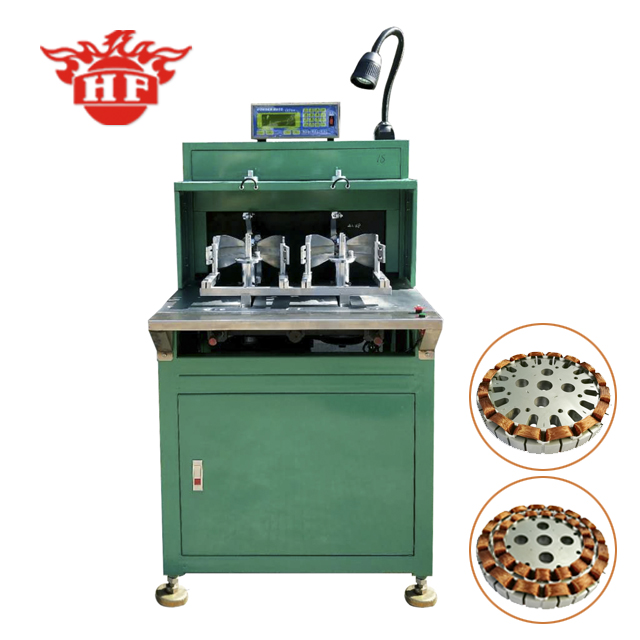
New HF Fan Motor Rotor Turning & Casting Machine
Engineered for aluminum surface cutting and precision rotor outer diameter finishing with integrated hydraulic pump core components.
- Air-gap concentricity: ±0.015 mm
- Core PLC + High-Pressure Coolant

Factory-direct high-precision rotor finishing, coil winding, insulation paper inserting, and certified rotor shaft components. Every unit is customized to your engineering drawings and verified via full-load customer stator prototype trials before export dispatch.
Engineered for aluminum surface cutting and precision rotor outer diameter finishing with integrated hydraulic pump core components.
High-speed external winding machine designed for transformer motors, BLDC stators, and dual-pole domestic fan motor assemblies.
Precision armature rotor slot coil flyer winder with dynamic tensioning, automatic commutator hooking, and zero wire scrape tolerances.
Dedicated high-torque two-station ceiling fan stator core coil winder engineered for both inner and outer stator slot configurations.
High-rigidity low-carbon SC45# steel and induction hardened iron shafts for domestic air coolers, table fans, and centrifugal pumps.
Heavy-duty rough OD turning lathe equipped with premium engine gears, heavy-cast machine beds, and automated coolant cycle filtration.
Precision finishing machine for induction motor rotors, securing tight magnetic gap clearances and reducing operational motor decibels.
Flagship 220V 1000W automatic insulation paper inserting machine for cooler and fan motors with edge creasing, auto cutting, and pushing.
In high-voltage, inverter-driven, and high-efficiency (IE3, IE4, IE5) electric motor production, stator slot insulation is the primary barrier preventing electrical breakdown, phase-to-ground flashover, and premature turn-to-turn burnout.
A critical failure mode in manual slot paper insertion is tearing at the core end-lamination burrs. Automated inserting machines execute cold mechanical creasing (single or double folding cuffs) along both margins of the insulation tape before feeding. This reinforced folded hem absorbs axial thrust when heavy magnet wire coils are pushed into the slot, preventing the bare copper from touching silicon steel edges and eliminating short-to-ground faults.
Traditional mechanical ratchets and cam dividers often generate progressive backlash over millions of punch strokes. Modern CE-compliant slot inserting machinery utilizes closed-loop AC servo drivers linked directly to precision planetary reducers. This enables dynamic pitch angle compensation, allowing the machine to insulate skewed slots, asymmetric stator configurations, variable-width slot geometries, and jump-slot insulation layouts without mechanical re-tooling.
Whether feeding Class B polyester film (Mylar), Class F/H Nomex®, DMD (Dacron-Mylar-Dacron), NMN, or pure polyimide laminates (0.15 mm to 0.45 mm thickness), the automated paper feeding system integrates high-carbide shear tooling and micro-adjustable heating units. This eliminates delamination, micro-fracturing along the fold creases, and maintains strict creepage distance compliance under IEC 60034-1 insulation test protocols.
As the electric mobility (e-Mobility), industrial servo, and smart domestic appliance industries transition to higher power densities, motor assembly equipment must evolve. Below is a strategic technical comparison outlining the technological shift underway.
| Evaluation Parameter | Legacy Machinery (Traditional Induction) | Next-Gen CE Certified Machinery (2025–2030) | Procurement & ROI Advantage |
|---|---|---|---|
| Drive Mechanism | Mechanical cams, manual gears & pneumatic valves | Full AC Multi-Axis Servo Synchronous Drive + Linear Guides | Eliminates mechanical wear, shortens re-tooling time by 70%, stabilizes long-term repeatability. |
| Lamination Accommodation | Fixed stack heights; manual shimming required | Servo-programmable stack height adjustment via HMI recipes | One machine handles varied core stacks (15 mm to 250 mm) without physical dismantling. |
| Slot Geometry Adaptability | Restricted to symmetrical round or trapezoidal slots | Compatible with parallel, hairpin, skewed, and closed slots | Enables procurement of future-proof platforms ready for EV traction & high-efficiency BLDC. |
| Dielectric Safety & CE Norms | Basic emergency stops and partial metal shrouds | EN ISO 12100 / EN 60204-1 safety interlocks, optical light curtains | Guarantees complete safety sign-off for EU, US, and Japanese tier-one automotive audits. |
| Digital Telemetry & Industry 4.0 | Isolated standalone control cabinet without data output | OPC-UA, Modbus TCP/IP, Ethernet/IP, remote cloud telemetry | Direct connection to factory MES for real-time OEE, predictive blade wear, and fault logging. |
Headquartered in Qishi Town, Dongguan — the world's epicenter of electromechanical hardware manufacturing — our factory has supplied high-reliability winding, inserting, and rotor assembly machines across 60+ countries for over 17 years.
Our physical assembly workshop, electrical wiring lines, and precision machining shops have been independently verified on-site. Buyers inspect our real operating premises, CNC machining centers, and live production capability through verified third-party audit reports.
We never force standard molds on custom motor designs. Our mechanical design team crafts paper insertion dies, forming fingers, and winding fixtures directly from your stator CAD blueprints (.dwg/.step) and verifies cycle performance on actual client core samples.
To ensure zero maintenance downtime overseas, our electrical systems are built with globally recognized components: Siemens or Mitsubishi PLCs, Delta or Panasonic servo motors, Schneider contactors, and SMC or Airtac pneumatic units readily accessible worldwide.
We eliminate inter-machine compatibility disputes. From slot paper inserting to coil winding, wedge inserting, coil forming, end-turn lacing, rotor turning, and shaft hydraulic pressing, we balance cycle times and standardize PLC interfaces across the entire line.
Every machine engineered in our Dongguan plant integrates seamlessly into an automated sequential stator production line, ensuring minimal labor intervention and consistent product quality.
The stator lamination stack is loaded. The machine feeds roll insulation, creases edges, cuts length to match stack height, forms the cell, and pushes it into each slot sequentially with automated servo indexing.
Multi-spindle or multi-station winders wrap copper or aluminum magnet wire into specified coil group configurations, maintaining precise layer winding tension without scratching enameling.
In one unified vertical stroke, the wound coil package and formed composite slot wedges (bamboo, epoxy, or plastic) are drawn simultaneously into the insulated stator core slots.
Hydraulic or pneumatic expanding shoes press the overhang coil heads outward and downward, clearing the stator bore ID so that rotor clearance is maintained and phase separators can be placed.
High-speed needles bind the coil end-windings with wax cord using diamond, continuous, or jump-stitch patterns, ensuring mechanical stability against electromagnetic vibration.
Precision exterior and interior dies compress the laced stator heads to their final mechanical envelope dimensions, guaranteeing zero housing interference during motor final assembly.
The motor rotor core receives high-speed outer surface lathe turning (HF-C60 series) to calibrate strict magnetic air-gap concentricity (≤0.015 mm), followed by controlled servo hydraulic shaft press-fitting with real-time pressure-displacement monitoring.
Everything you need to evaluate machine reliability, custom tooling requirements, export logistics, electrical compliance, and after-sales field support.
To fabricate precision paper feeding dies, cuffing guides, and indexing mandrels, our mechanical engineering department requires: (1) Stator lamination drawing showing Outer Diameter (OD), Inner Bore Diameter (ID), and total Slot count; (2) Detailed slot dimensions (slot opening width, tooth width, slot depth, and corner radii); (3) Stator stack height range (min/max mm); and (4) Selected insulation material type (e.g., DMD, Nomex, Polyester) along with paper thickness (typically 0.15 mm – 0.35 mm). Sending physical blank stator lamination packs ensures 100% pre-delivery validation.
Our inserting machines incorporate a dual-action forming and pushing mechanism. First, heated or pre-tensioned mechanical creasers press sharp, fatigue-resistant edge cuffs. Second, the formed paper cell is pushed through a dedicated carbide guide bush that matches the exact cross-section of your stator slot. The insertion rod drives the paper fully home until the rear cuff clears the stack end-plate, ensuring zero spring-back, perfect axial centering, and immediate retention against lamination teeth.
Yes. For identical slot cross-sections with varying stack heights (e.g., 20 mm, 35 mm, and 50 mm heights sharing the same punching die), you can adjust the feeding length directly on the touchscreen HMI in seconds. If the stator has a different slot count, ID, or slot profile, our quick-change tooling system allows operators to swap the indexing spindle plate and insertion blades within 20 to 30 minutes, minimizing production changeover downtime.
We build our machines strictly compliant with the CE Machinery Directive 2006/42/EC and Low Voltage Directive 2014/35/EU. Standard operating units operate on 220V 50/60Hz single-phase or 380V/415V/480V 50/60Hz three-phase supplies according to your factory's local grid standards. Control circuits run on safe 24V DC. Industrial PLC hardware can be branded to your local preference (Siemens, Mitsubishi, Delta, or Omron) for effortless plant-wide standardisation.
All machines carry an unconditional 1-year mechanical and electrical core warranty. Every shipment includes a free vulnerability spare-parts kit (punching blades, creasing cutters, push rods, timing belts, and proximity sensors). We provide comprehensive high-definition video commissioning tutorials, circuit schematics, and English operating manuals. For full turnkey stator lines, our field engineering team can be deployed on-site for factory installation, calibration, and local personnel operational training.
Every machine is heavily treated with industrial anti-rust grease on all unpainted ground-steel components, vacuum-wrapped in puncture-resistant moisture-barrier VCI foil with industrial desiccant bags, bolted directly through heavy steel floor skids, and enclosed inside a fumigation-free ISPM-15 compliant export plywood case. Machines arrive at European, North American, or Southeast Asian ports factory-fresh and ready for immediate anchoring.
Send your stator core drawings, stack heights, and target shift output to our senior automation engineers. We review your specifications and provide a detailed technical recommendation, tooling blueprint, and formal FOB/CIF factory quotation within 9 hours.